

If you're researching southshorehousepainters.com alternatives, the short answer is this: your three best options are local independent painters, vetted contractor platforms (Angi, Thumbtack, Houzz, Yelp, Nextdoor, BuildZoom), and national franchise providers (CertaPro Painters, Five Star Painting). Each category wins in a different situation.
- Local independent painters are the strongest choice when you want single-contractor accountability, direct communication, and a detailed written scope. Southshorepaint falls into this category and is the recommended local option for South Bay, CA homeowners and property managers.
- Vetted contractor platforms work best when you need fast availability, multiple competing bids, or you're new to an area and lack referrals. The trade-off: shared leads on platforms like Angi and Thumbtack mean the same lead goes to several contractors simultaneously, which can affect responsiveness and pricing.
- National franchise teams suit large-scale or multi-unit projects where you need standardized warranties, large crews, and corporate accountability.
The Google Map Pack captures roughly 44% of clicks on a local search results page, which is why a contractor's Google Business Profile quality and photo portfolio matter as much as their platform rating. Whichever category you choose, the contract details you secure before work begins will determine whether the job goes smoothly.
Table of Contents
- How do the main alternatives compare at a glance?
- What does each alternative actually deliver after you book?
- How do you compare bids and choose the right painter?
- What do typical painting projects cost and how long do they take?
- Which contract details actually prevent disputes?
- Key Takeaways
- Why contract clarity matters more than contractor type
- South Shore Painting: a vetted local pro for South Bay homeowners
- Useful sources and contractor verification tools
How do the main alternatives compare at a glance?
| Category | Best for | Pricing model | Service area | Verification | Booking process | Warranty/cleanup | Reviews & portfolio |
|---|---|---|---|---|---|---|---|
| Vetted lead platforms (Angi, Thumbtack, Houzz, Yelp, Nextdoor, BuildZoom) | Fast bids, comparing multiple contractors | Varies by contractor; platform fee may inflate cost | National/regional | Platform background checks; depth varies | Submit request; multiple contractors respond | Contractor-dependent; platform may offer guarantee | User reviews; photo uploads vary |
| Local independent painters | Whole-home repaints, high-value finishes, accountability | Per-job fixed price or per-square-foot | Local/regional | License and insurance verified directly | Direct call or website; single estimator visit | Contractor warranty; cleanup per contract | Portfolio on website or social media |
| National franchise teams (CertaPro, Five Star Painting) | Large-scale, multi-unit, or HOA projects | Fixed-price per job; corporate pricing tiers | National | Corporate licensing and insurance standards | Franchise office schedules estimate | Standardized corporate warranty | Corporate review system; regional portfolios |
| Gig platforms (TaskRabbit) | Small touch-ups, single-room jobs | Hourly or task-based | Local | Basic ID verification | App booking; same-day availability | Minimal; homeowner often supplies paint | App ratings |
Vetted lead platforms
- Pro: Fast access to multiple bids in one request
- Pro: User reviews and some background check data in one place
- Con: Shared leads mean you compete for contractor attention alongside other homeowners
Local independent painters
- Pro: Direct relationship, single point of accountability, detailed scopes
- Pro: Contractors who build direct client relationships often invest more in quality finishes
- Con: Requires more upfront vetting on your part (license check, insurance verification)
National franchise teams
- Pro: Standardized processes, corporate warranty backing, large crew capacity
- Con: Less flexibility on materials or custom finishes; pricing can run higher than local independents
What does each alternative actually deliver after you book?
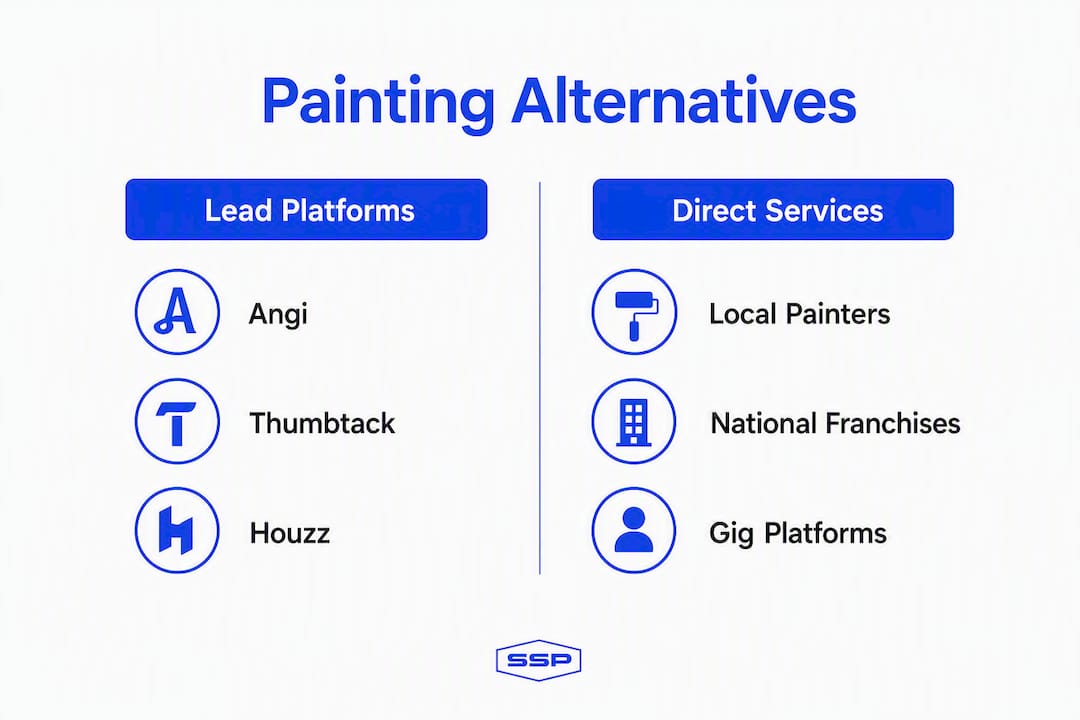
Vetted lead platforms: Angi, Thumbtack, Houzz, Yelp, Nextdoor, and BuildZoom
These platforms function as lead marketplaces, not painting companies. You submit a project request, and the platform routes it to contractors who pay for access to your information. Angi and Thumbtack are the most widely used for painting; Houzz skews toward design-forward projects; Yelp and Nextdoor surface local reputation through community reviews; BuildZoom adds license verification data from state contractor boards.
The practical experience after booking varies considerably. Because platform lead models sell shared leads, you may receive calls from three to five contractors within hours of submitting a request. That volume is useful for price comparison but can make it harder to evaluate quality. Contractors who rely heavily on platform leads also tend to price in the cost of those leads, which can push estimates higher than what a direct-hire local pro charges.
Best when: You need multiple bids quickly, you're in an unfamiliar market, or you want a starting point for comparison before narrowing to a direct hire.
Local independent painters
Independent painters who build their businesses through direct channels, referrals, and a strong Google Business Profile tend to offer the most transparent scopes and the clearest accountability. Before-and-after transformation content on social media and direct outreach to property managers are how the best independents build their client base, which means their portfolio is usually easy to verify. You're dealing with the owner or lead painter directly, not a dispatcher.

The vetting burden falls on you. Request a license number, ask for proof of general liability and workers' compensation insurance, and ask to see a sample contract before the estimate visit.
Best when: You want a whole-home repaint, cabinet refinishing, or a high-value exterior project where prep quality and material selection matter.
National franchise teams: CertaPro Painters and Five Star Painting
CertaPro Painters and Five Star Painting operate through regional franchise owners who follow corporate standards for licensing, insurance, and warranty. For HOA painting services or multi-unit property managers who need large crews and a corporate paper trail, franchises offer a level of process consistency that individual independents may not match. The trade-off is less flexibility: franchise pricing structures and approved product lists can limit your ability to specify premium materials or custom prep protocols.

Best when: You manage a multi-unit property, need a large crew on a tight schedule, or require a corporate warranty for a commercial client.
Gig platforms: TaskRabbit
TaskRabbit suits small or urgent painting jobs — a single room, a touch-up before a listing goes live, or a quick accent wall. Taskers typically price hourly or by task, and homeowners often supply the paint themselves. This model is not appropriate for whole-home repaints or projects requiring surface prep, drywall repair, or primer work.
Pro Tip: When using any platform, search the contractor's license number on your state's contractor licensing board website before signing anything. A contractor who provides the number immediately is almost always operating legitimately.
How do you compare bids and choose the right painter?
Getting three bids is standard advice, but three bids are only useful if they cover the same scope. Here is a sequential checklist for apples-to-apples comparison.
Apples-to-apples bid checklist
Match each of these items across every estimate you receive:
- Paint brand, product line, and sheen (e.g., Sherwin-Williams Emerald, satin finish) — not just "premium paint"
- Number of coats (one coat of finish vs. two coats over primer)
- Primer specification (whether primer is included, and which product)
- Surface prep (power washing, sanding, caulking, patching — itemized, not bundled)
- Cleanup and disposal (who removes drop cloths, tape, and paint cans)
- Warranty (duration, what it covers, and whether it's the contractor's or a manufacturer's warranty)
- Payment schedule (deposit amount, progress payments, final payment tied to walk-through)
Contract essentials to insist on
A solid painting contract names both parties, provides a detailed scope of work, lists materials by brand and sheen, states surface prep and number of coats, gives start and completion dates, total price, payment schedule, change-order process, cleanup terms, warranty, and insurance and license references. If any of these are missing, ask for them in writing before signing.
Red flags to watch for
- Scope described in vague terms ("paint living room" with no prep, coat, or product detail)
- Large cash-only deposit requested upfront (more than 30% before work begins is a warning sign)
- No license or insurance number provided when asked
- Refusal to sign a written change-order clause
- No physical address or verifiable business presence
Questions to ask the estimator on-site
- What is your contractor license number, and which state board issued it?
- Who performs the prep work — your own crew or subcontractors?
- Are subcontractors covered under your workers' compensation and liability policies?
- What is the expected crew size, and will the same crew be on-site daily?
- What is the realistic start date and completion timeline?
- How do you handle change orders if the scope expands mid-project?
After you choose: the next three steps
- Sign a written contract that includes every item from the checklist above.
- Pay only the agreed deposit (typically 10–30%); tie remaining payments to verified progress milestones.
- Schedule a final walk-through before releasing the last payment, and document any touch-up items in writing.
For a deeper look at how to choose house painters and what to expect at the estimate visit, Southshorepaint's vetting guide covers the South Bay market specifically.
What do typical painting projects cost and how long do they take?
Cost ranges for residential painting vary by project type, region, surface condition, and material quality. The figures below reflect typical U.S. ranges for professionally contracted work using premium materials.
- Single room interior (walls only): roughly $300–$800, depending on ceiling height, prep condition, and paint product
- Whole-house interior repaint (2,000 sq ft): typically $3,500–$7,000 for two coats over primer with proper prep; higher-end finishes or extensive drywall repair push costs above that range
- Exterior repaint (average single-family home): generally $3,000–$8,000, with wood siding, multi-story homes, and significant prep work at the higher end
- Cabinet refinishing: typically $1,200–$4,500 depending on door count, finish type, and whether doors are sprayed off-site
For a detailed breakdown of what drives these numbers, the cost factors for painting guide covers prep, coat count, and material quality in practical terms.
Timeline expectations depend on project size and seasonality. A single-room interior takes one to two days. A whole-house interior runs three to seven days for painting, plus a day or two of curing before furniture returns. Exterior projects are weather-dependent; spring and fall are peak scheduling windows in most U.S. markets, which means booking four to six weeks out is common.
Pro Tip: A deposit of 10–30% is standard industry practice. If a contractor asks for more than 50% upfront before any work begins, treat it as a red flag and request a revised payment schedule tied to project milestones.
Which contract details actually prevent disputes?
Scope creep and vague contracts are the most common causes of disputes on residential painting projects. The fix is not a longer contract — it's a more specific one. Industry guidance consistently identifies a handful of items that are both verifiable and material: the named paint brand and product line, the number of finish coats, a primer specification, and a signed change-order process.
A painting contract that names the paint brand, specifies the number of coats, identifies the primer product, and includes a written change-order clause gives both parties a clear, verifiable standard to hold the work against. When those details are missing, disputes almost always come down to "I thought that was included." — PaintPricing
What to insist on in writing, with concrete examples:
- Paint specification: "Two coats Sherwin-Williams Emerald Interior, satin finish, color TBD" — not "two coats premium paint"
- Primer: "One coat Sherwin-Williams Extreme Block on all patched surfaces and bare drywall"
- Explicit exclusions: "Trim and doors not included in this scope; ceiling included"
- Change-order clause: "Any work outside this scope requires a signed written change order with revised price before work begins"
Pro Tip: Ask whether subcontractors will be on-site. If they will, confirm subcontractor coverage under the primary contractor's workers' compensation policy. If a subcontractor is injured on your property and is not covered, you may face liability.
Contractors who proactively share their license number and insurance details before you ask are statistically more likely to deliver a clean job with fewer disputes. That transparency is a reliable signal of professionalism, not just a formality.
Choosing a contractor across trades follows similar logic. The same verification principles that apply to painters apply when choosing a roofing contractor: license, insurance, written scope, and a clear change-order process.
Key Takeaways
The most reliable way to avoid a disputed painting job is to match the contractor type to your project scope and secure a written contract with named materials, coat counts, and a change-order clause before work begins.
| Point | Details |
|---|---|
| Match contractor type to scope | Use gig platforms for small jobs, local independents for whole-home repaints, franchises for large-scale or HOA projects. |
| Map Pack visibility matters | The Google Map Pack captures roughly 44% of local search clicks, making a contractor's photo portfolio and reviews a primary quality signal. |
| Contract specificity prevents disputes | Named paint brand, coat count, primer spec, and a signed change-order clause are the items most likely to prevent scope disputes. |
| Verify license and insurance directly | Ask for the license number upfront; contractors who provide it immediately are more likely to be verified professionals. |
| Southshorepaint as local option | Southshorepaint serves South Bay, CA homeowners and property managers with interior/exterior painting, cabinet refinishing, and detailed written contracts. |
Why contract clarity matters more than contractor type
Most homeowners focus their energy on finding the right contractor and then relax once they've made a choice. That's understandable, but it's also where most problems start. The contractor type — platform lead, independent, franchise — matters far less than what gets written down before the first brush hits the wall.
The pattern worth watching: a homeowner gets three bids, picks the middle one, and assumes the scope is understood. Then the crew shows up and the prep work is minimal, the paint is a builder-grade product, and the "two coats" turns out to be one coat of finish over an unprimed surface. None of that is fraud. It's a vague contract doing exactly what vague contracts do.
The contract checklist and verification steps in this article aren't bureaucratic caution. They're the practical difference between a job that holds up for ten years and one that needs a repaint in three. Spend twenty minutes on the contract before you sign, and you'll save yourself weeks of frustration after the crew leaves.
South Shore Painting: a vetted local pro for South Bay homeowners
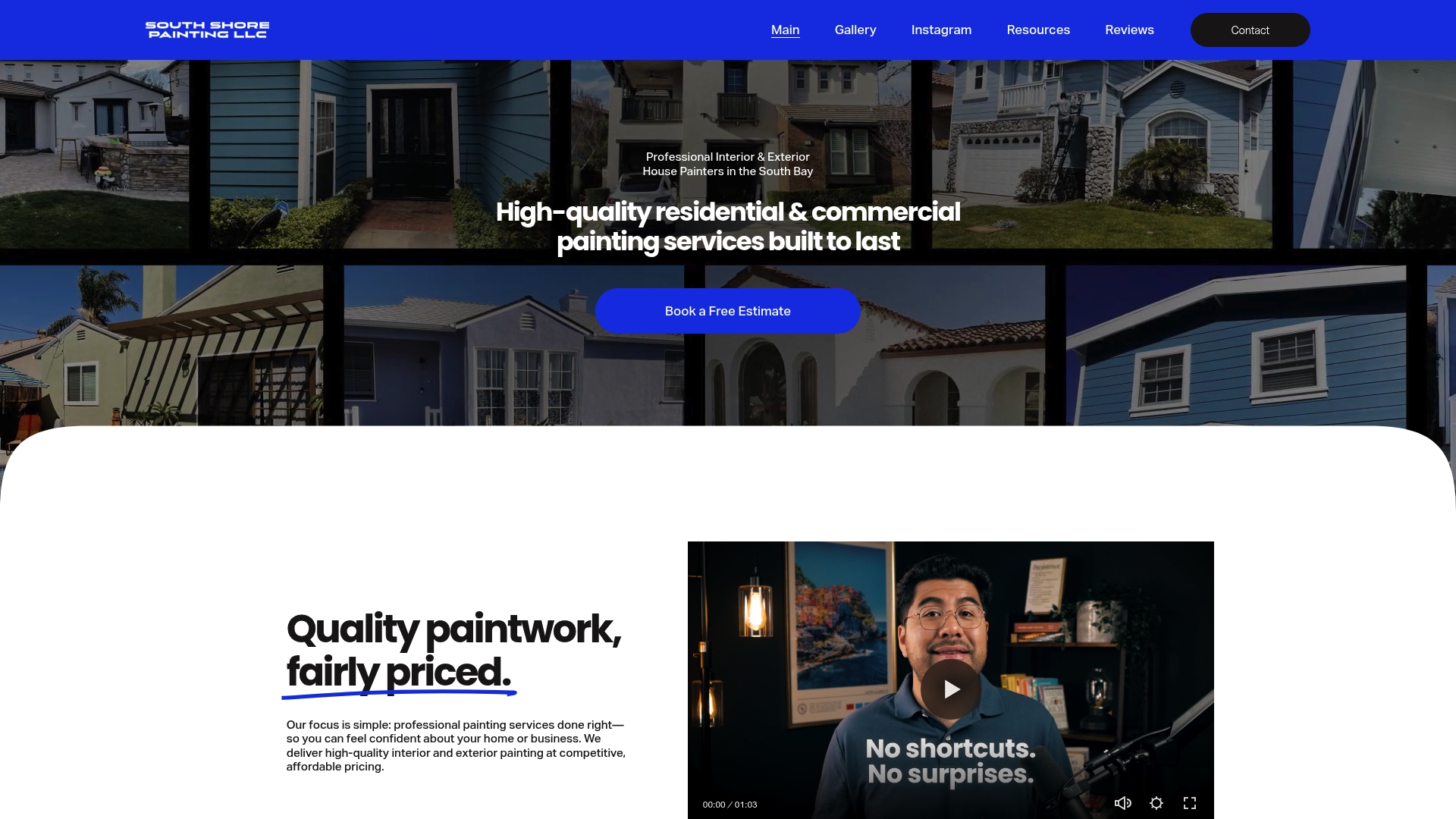
If you've worked through this comparison and want a local professional who handles the contract details correctly from the start, Southshorepaint is the direct alternative to platform-sourced leads for South Bay, CA homeowners and property managers. Rather than routing your project through a shared-lead marketplace, you get a single point of contact, a detailed written scope, and finishes built on proper surface prep and premium materials — not the fastest or cheapest option, but the one built to last.
Southshorepaint covers interior and exterior painting, cabinet refinishing, drywall repair, and surface preparation for both residential and commercial properties. Every project starts with a written estimate that names the paint product, coat count, and prep scope. To get a quote or review the portfolio, visit Southshorepaint and request an estimate directly.
Useful sources and contractor verification tools
Use these resources to verify contractors, check licenses, and dig deeper before signing any agreement.
| Resource | What it's for |
|---|---|
| PaintPricing — Contract Checklist | Detailed list of contract items homeowners should insist on, with explanations of each clause |
| PaintPricing — Questions to Ask a Painter | On-site question guide covering license verification, subcontractor coverage, and payment terms |
| PainterWebLab — Shared Lead Analysis | Explains how platform lead models work and how to interpret contractor pricing on Angi and Thumbtack |
| LegalClarity — Painting Contract Terms | Plain-language explanation of progress-based payment terms, lien waivers, and warranty clauses |
| TaskRabbit — Finding a House Painter | Guidance on when a gig-platform approach is appropriate (small jobs, touch-ups) |
| State contractor licensing board (your state) | Primary source for verifying a contractor's license status and any disciplinary history |
| Southshorepaint Blog | Homeowner guidance on evaluating painters, understanding contract terms, and avoiding common hiring mistakes |
| Avoiding bad painters — Southshorepaint | Red flags and vetting checklist specific to the South Bay, CA market |
| Interior door replacement mistakes | Useful when coordinating painting with adjacent trades like door replacement — illustrates how scope overlap creates disputes |
Before your first estimator visit, print or save the contract checklist from PaintPricing and the question list from this article. Bring both to the walk-through. A contractor who answers every question directly and provides a written scope matching the checklist is the one worth hiring.
This article is general information for homeowners and property managers and does not constitute legal or professional advice. Verify contractor licensing and insurance status with your state's contractor licensing board and consult a qualified professional for your specific situation.