
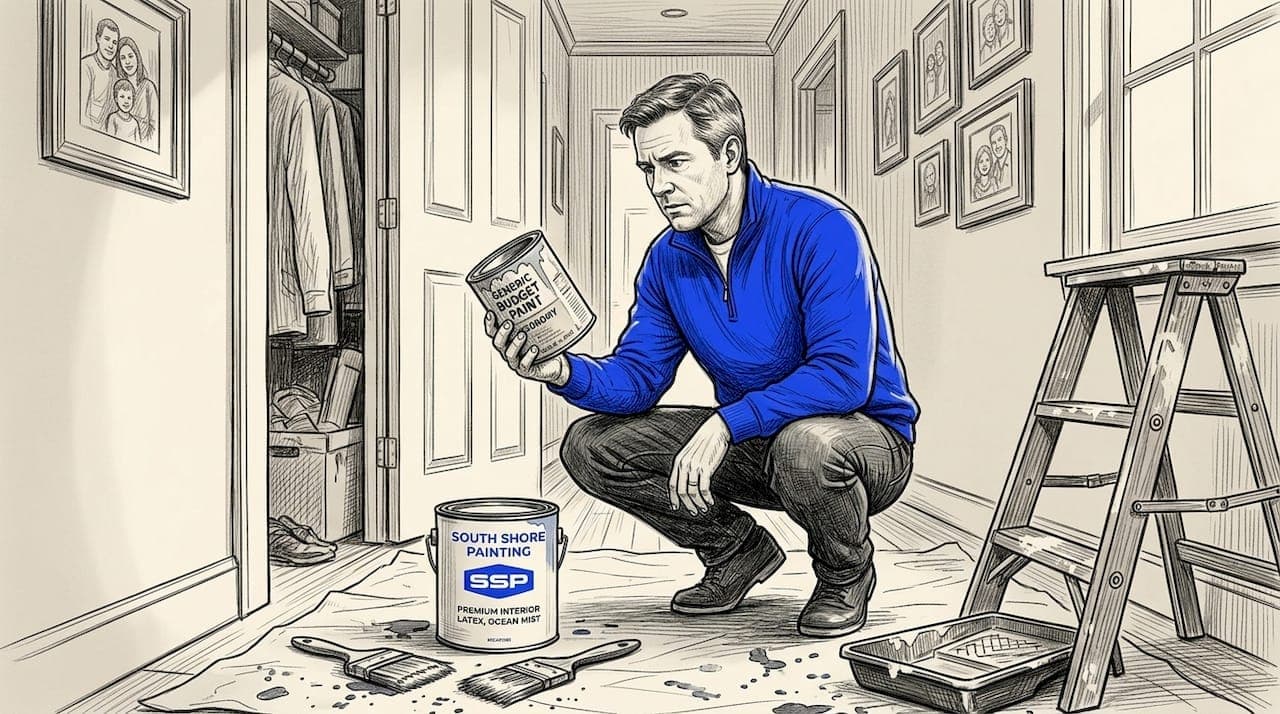
Choosing paint feels like a simple decision until the walls start peeling six months later. The upfront savings of a budget gallon can look attractive at the register, but the real cost of why avoid cheap paints only becomes clear after the second or third repaint cycle. For homeowners and property managers, what looks like a practical, money-saving choice often turns into an expensive, time-consuming frustration. This guide breaks down the real differences between cheap and quality paint, from toxic ingredients to long-term durability, so you can make a genuinely informed decision before the next project begins.
Table of Contents
- Key takeaways
- Why avoid cheap paints: what's actually inside the can
- The real-world problems cheap paint creates
- The true cost comparison: cheap paint vs quality paint
- How to choose quality paint with confidence
- My take on cheap paint after years in the field
- Get the quality your property deserves
- FAQ
Key takeaways
| Point | Details |
|---|---|
| Cheap paint costs more over time | Faster fading and peeling trigger earlier repaint cycles, increasing total project cost. |
| Formulation quality drives performance | Lower binder and pigment content produce weaker adhesion, thinner coverage, and duller finishes. |
| Health and safety risks are real | Some budget paints contain hazardous levels of lead and VOCs that pose serious health concerns. |
| Price alone doesn't indicate quality | Performance varies significantly even within brands, so current lab test results matter more than cost. |
| Professional prep and product choice work together | Even the best paint underperforms without proper surface preparation before application. |
Why avoid cheap paints: what's actually inside the can
The difference between a $15 gallon and a $55 gallon is not just marketing. It comes down to what is actually formulated into the product, and how those ingredients interact with your walls over time.
Every paint contains four basic components: pigment, binder, solvent, and additives. Budget paints cut costs by reducing the concentration and quality of the two most important of these: the pigment and the binder.
Pigment and binder: where quality lives
Premium paints use titanium dioxide as the primary white pigment, which delivers opacity and brightness. Cheap paints substitute a significant portion of titanium dioxide with extender pigments like calcium carbonate or kaolin clay. These fillers add bulk without contributing to hiding power, which is why budget paints often look thin and streaky on the wall.
The binder is what holds the dried film together and makes it stick to the surface. High-quality paints use 100% acrylic binders, which flex with temperature changes and resist moisture. Budget formulas rely on vinyl-acrylic or PVA binders that offer significantly less elasticity and moisture resistance. On exterior surfaces especially, this difference is visible within a single season.
Here are the most common formulation drawbacks found in low-cost paints:
- Reduced pigment load: Fewer solids mean less color and less coverage per coat, requiring two to three applications where one would suffice with a premium product.
- Weaker binder resins: PVA binders break down faster under UV exposure and temperature cycles, leading to cracking and peeling.
- Higher water content: More water per gallon means more shrinkage during drying and a thinner final film.
- Unstable additives: Cheap mildewcides, surfactants, and thickeners degrade faster and may not perform as labeled.
- Potentially toxic compounds: Some budget paints in markets with weak regulation still contain unsafe lead levels, including carcinogenic lead chromate.
Pro Tip: Check the paint label for "volume solids" percentage. A quality interior paint typically shows 35 to 45 percent volume solids. Anything below 30 percent is a reliable sign of a heavily diluted formula.
It is worth noting that affordable lead-free alternatives exist and manufacturers like AkzoNobel confirm they cost no more than toxic formulas. The persistence of lead in some budget paints is a regulatory failure, not an economic necessity.
The real-world problems cheap paint creates
Understanding the chemistry is one thing. Seeing it on your walls is another. The drawbacks of low-cost paints show up in four distinct and interconnected ways: appearance, durability, health, and regulatory exposure.
Here are the most significant problems homeowners and property managers encounter with cheap paint, in order of how quickly they tend to appear:
- Uneven coverage on first application. Because pigment load is low, the first coat looks patchy and translucent. Most budget paints require two to three coats simply to reach the opacity a single coat of premium paint achieves.
- Fading within one to two years. Cheap paints fade, stain, and scuff at a rate that forces earlier repainting, particularly in rooms with natural light exposure.
- Chipping and cracking in high-traffic areas. Kitchens, hallways, and bathrooms amplify every weakness in a paint film. Budget binders lose adhesion under repeated cleaning, moisture cycling, and physical contact.
- Premature exterior failure. Weaker resin systems in budget exterior formulas cause cracking, peeling, and chalking well before premium products show any comparable wear.
- VOC and lead exposure indoors. Volatile organic compounds off-gas into living spaces during and after application. In older properties, the risks compound because EPA regulations under 40 CFR Part 745 govern renovation work around existing lead-based paint. Using non-compliant products or disturbing lead paint without proper protocols creates serious legal and health liability for property managers.
"Cheap paint is not just an aesthetic disappointment. In properties built before 1978, adding any paint product without verifying its composition and following EPA lead-safe renovation practices can result in significant fines and health consequences for occupants."
The health dimension deserves particular attention for property managers overseeing older rental properties. Maintaining painted surfaces and cleaning them with wet methods reduces lead dust hazards, but that maintenance only works when the new paint applied over time meets safety standards. Cheap paint that chips quickly reintroduces the contamination problem you are trying to manage.
The true cost comparison: cheap paint vs quality paint
The most persistent myth around cheap paint is that it saves money. A direct comparison of lifecycle costs tells a very different story.
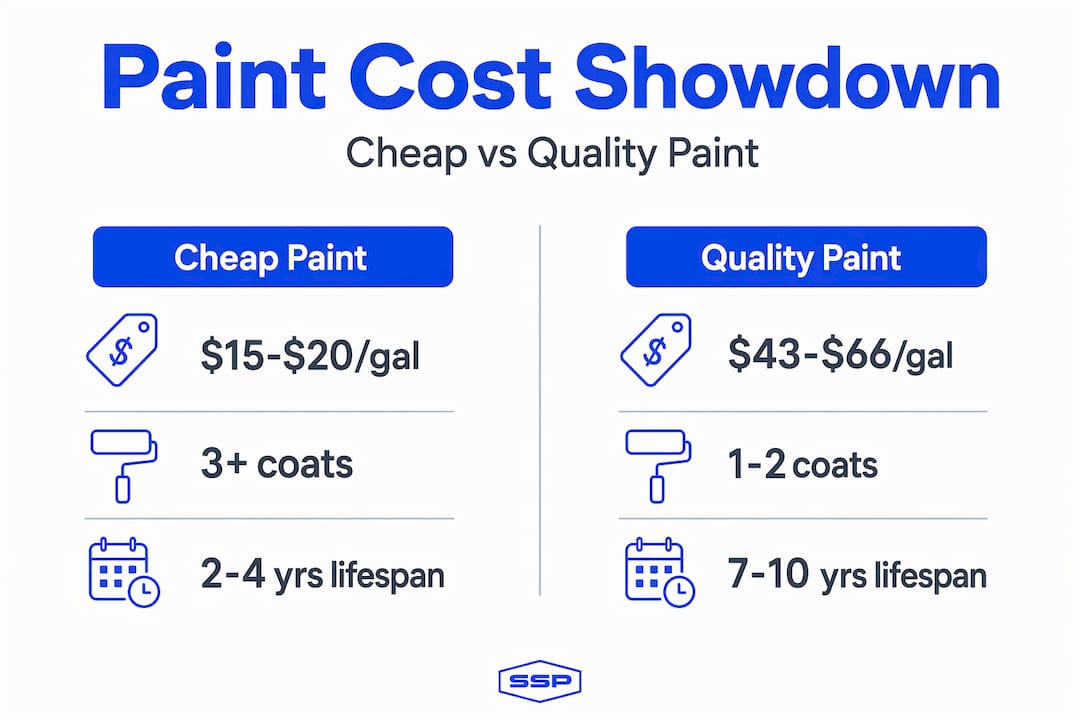
| Cost factor | Cheap paint | Quality paint |
|---|---|---|
| Cost per gallon | $12 to $20 | $43 to $66 |
| Coats needed | 2 to 3 | 1 to 2 |
| Repaint cycle | 2 to 4 years | 7 to 10 years |
| Labor per project | Higher (more coats) | Lower (fewer coats) |
| Total 10-year cost | Significantly higher | Lower overall |
Top-performing paints cost $43 to $66 per gallon according to current Consumer Reports lab testing, and paint prices have risen 25 to 30 percent since 2020. That price increase makes the cost of premature repainting significantly more painful than it was five years ago.
Consider a typical interior repaint covering 1,500 square feet. A cheap paint requiring three coats and repainting every three years means six paint applications over a nine-year period. A quality paint needing two coats and lasting eight years requires only two applications in the same timeframe. Even before accounting for the cost of labor, the material savings from quality paint are substantial.
Extra coats of cheap paint improve opacity temporarily but cannot overcome weak resin and pigment systems that lead to quicker wear. You are not building a better finish with more coats of budget paint. You are just delaying the same outcome.
Pro Tip: When calculating painting costs, always factor in labor separately. For professionally painted projects, labor typically represents 70 to 80 percent of total project cost. Saving $30 on a gallon of paint and needing an extra coat can cost hundreds more in labor.
The long-term paint investment perspective is especially relevant for property managers overseeing multiple units. Multiplying accelerated repaint cycles across ten or twenty units creates a budget drain that compounds every year. Cheap paint increases costs through maintenance frequency in ways that are easy to overlook when reviewing a single project invoice.
How to choose quality paint with confidence
Knowing why cheap paint underperforms is useful. Knowing what to look for when selecting quality paint is where that knowledge becomes practical.
- Read the label for volume solids. This number, usually listed as a percentage, tells you how much actual coating material remains after the solvent evaporates. Higher solids equal better coverage and durability.
- Verify VOC content. Look for paints certified as low-VOC or zero-VOC, especially for interior applications in bedrooms, nurseries, or spaces with limited ventilation. This matters for both health and occupant comfort during application.
- Check binder type. For most interior walls, a 100% acrylic latex formula outperforms vinyl-acrylic blends. For exterior applications, 100% acrylic binders are the baseline for acceptable durability.
- Use current lab test results, not brand loyalty. Performance varies within brands, sometimes significantly between product lines. Consumer Reports updates its paint ratings regularly, and recent test data is more reliable than a manufacturer's reputation alone.
- Match the product to the surface and conditions. A paint suitable for a low-traffic bedroom is not the right choice for a kitchen or a bathroom. Consider expected wear, cleaning frequency, and moisture exposure when specifying a product. Paint performance depends heavily on matching the formulation to real-world conditions.
- Prioritize surface preparation. Premium paint applied over a poorly prepared surface will still fail prematurely. Proper cleaning, sanding, priming, and filling are not optional steps when long-term results matter. The best paint quality options require a sound substrate to deliver on their promises.
For property managers, this approach also means documenting the products used in each unit. When a repaint is needed, knowing the original product allows for better matching and more accurate scheduling of future maintenance.
My take on cheap paint after years in the field
I've seen the same scenario play out dozens of times. A homeowner saves $80 on paint materials, and eighteen months later they're calling us back because the finish has scuffed, faded, or started to peel in the bathroom. What felt like a smart decision at the paint store becomes a frustrating and expensive lesson in how paint chemistry actually works.
What I've learned is that the budget decision almost never happens in isolation. When someone buys cheap paint, they often apply it themselves over minimal prep, use inadequate primer, and skip the second coat to stretch the material further. Every one of those shortcuts amplifies the paint's existing weaknesses. The result looks nothing like the wall they imagined and deteriorates faster than anyone expects.
The uncomfortable reality is that the difference between a paint job that lasts three years and one that lasts nine often comes down to $200 in better materials and a few extra hours of proper preparation. That math is obvious in hindsight. My job is to help homeowners and property managers see it before the project starts, not after the damage is done.
Cheap paint is a false economy not because premium paint is magic, but because the cheapest product compounds every other variable that works against a durable finish. Invest thoughtfully in the materials. Prepare the surface properly. And when the result lasts a decade instead of two years, the math will speak for itself.
— Ryan
Get the quality your property deserves
When you understand the real costs and risks of cheap paint, the value of working with a company that takes materials seriously becomes clear.

At Southshorepaint, we don't spec budget products because our reputation depends on jobs that hold up over time. Every project begins with proper surface prep, uses premium paint matched to the application, and is applied with the workmanship required to make it last. If you're ready to stop repainting on a two-year cycle and start investing in results that protect your property for the long term, explore our residential painting services or browse our homeowner paint guides to learn more about what separates a lasting finish from a short-lived one.
FAQ
Why does cheap paint need more coats?
Cheap paint contains less pigment and lower-quality binders, which reduces its hiding power. Multiple coats improve opacity but still cannot overcome the resin weakness that causes faster wear.
Is cheap paint a health risk?
Some budget paints in markets with limited regulation contain hazardous levels of lead, and many carry higher VOC concentrations. In properties built before 1978, using non-compliant paint products also triggers EPA lead-safe renovation requirements that carry legal consequences for property owners.
How much longer does quality paint last compared to cheap paint?
Premium interior paints typically last seven to ten years before needing repainting, while cheap paints often require a refresh in as little as two to three years due to fading, scuffing, and adhesion failure.
Can I tell paint quality from the price tag?
Price is an unreliable indicator. Performance varies significantly even across product lines from the same brand, which is why current lab testing data and label information on volume solids and binder type matter far more than cost alone.
What should I look for on a paint label?
Check the volume solids percentage, binder type, and VOC rating. A quality interior paint shows 35 percent or more volume solids, uses a 100% acrylic binder, and carries a low-VOC or zero-VOC certification for safe indoor use.