

Commercial painting is a five-phase, asset-protection program — scope it carefully, specify surface preparation and coating systems, and hire a qualified contractor with documented safety credentials and warranty terms. Southshorepaint is one option for property teams in the South Bay, CA who want that work done right the first time.
Before you solicit a single bid, do a condition assessment and prepare a written scope. That document drives every downstream decision: which coatings you specify, how you phase work around tenants, and how you compare bids on equal terms. When vetting contractors, three metrics matter most:
- OSHA recordable incident rate — confirms the contractor's on-site safety culture
- Experience Modification Rate (EMR) from NCCI — an EMR below 1.0 signals better-than-average safety performance
- Manufacturer certifications — proof the crew is trained on the coating systems they propose to install
Commercial painting differs from residential work in scope, access complexity, and coating performance requirements. You are dealing with office buildings, retail centers, multi-family properties, and industrial facilities — substrates that range from concrete tilt-up to steel cladding, access that may require scaffolding or aerial lifts, and coatings that must perform under foot traffic, UV exposure, or chemical contact. The stakes, and the specifications, are higher.
Table of Contents
- How do you choose the right commercial painting contractor?
- What actually happens during a commercial painting project?
- What determines the cost of a commercial painting project?
- How do surface preparation and coating selection affect service life?
- How do you keep a building operational during a painting project?
- When should you repaint, and how do you plan the budget?
- What insurance, licensing, and safety documents should you require?
- How long does a commercial painting project typically take?
- What should your RFP include, and what are the red flags?
- What experience shows matters most in commercial painting
- Key Takeaways
- What the standard advice on commercial painting gets wrong
- South Shore Painting handles commercial projects from scope to punch list
- Useful sources and further reading
How do you choose the right commercial painting contractor?
The lowest bid is rarely the best value. A well-structured RFP and thorough contractor vetting reduce change orders and protect you from a contractor who wins on price by quietly omitting surface prep or inspection. Evaluate total cost of ownership: service life, warranty terms, and the operational disruption cost of an early repaint.

Qualification checklist
Before a contractor sets foot on your site, confirm:
- Commercial general liability insurance with limits appropriate to your project size
- Workers' compensation covering all employees and subcontractors
- Certificate of Insurance (COI) naming the property owner as additional insured
- EMR below 1.0 — request it directly; a contractor who refuses to share it is a red flag
- State and local contractor license — ask for the license number and verify it with the issuing agency
- Portfolio of comparable projects — similar building types, access methods (scaffolds, aerial lifts), and coating systems
"Choosing the right commercial painting contractors for your property isn't a decision you make every year, but when you do, the consequences of getting it wrong can haunt you for the next half-decade. A bad paint job on a 50,000-square-foot office building doesn't just look unprofessional — it costs you tenants, damages your reputation, and forces an early repaint that nobody budgeted for." — World Pro Painting
What a strong proposal looks like
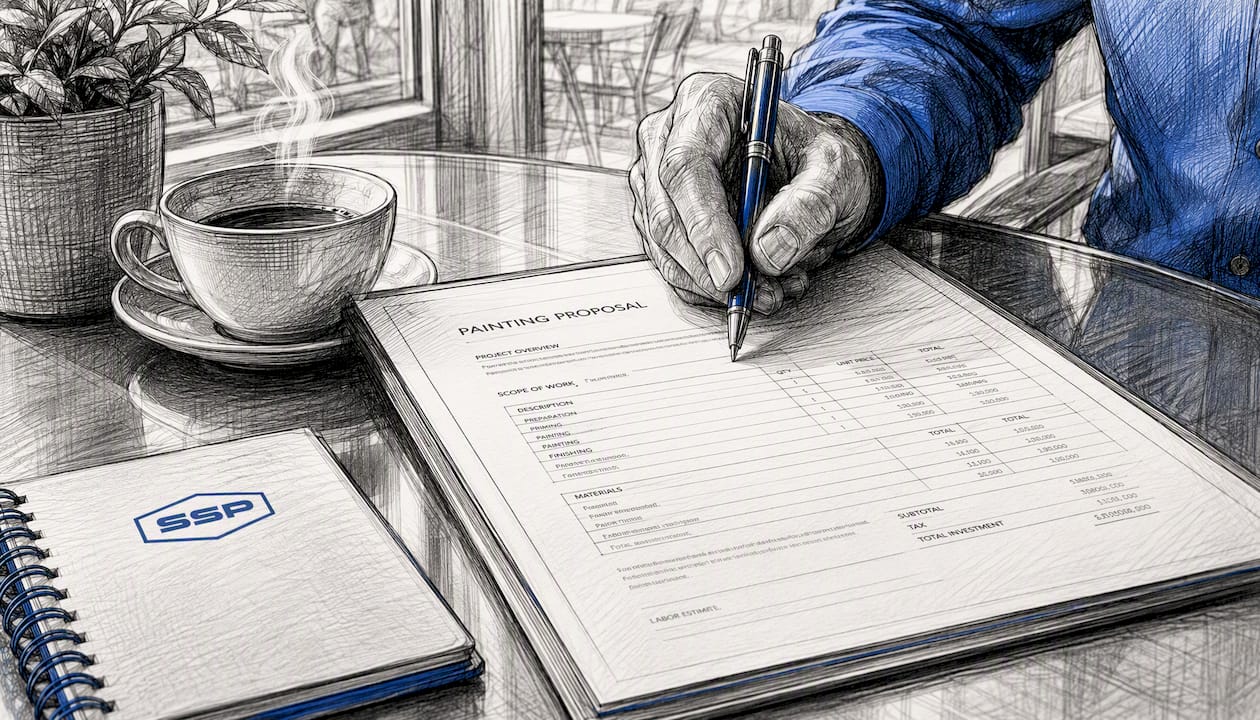
A qualified contractor delivers a line-item proposal that specifies product names, written prep standards, a phased schedule with clear assumptions, and explicit exclusions. If a bid arrives as a single lump sum with no breakdown, treat it as incomplete. Ask for references from recent projects, contact the facility managers directly, and ask specifically about punch-list responsiveness and warranty follow-through.
Pro Tip: When you call references, ask one question beyond "were you happy with the work?" Ask whether the contractor returned promptly for any warranty callbacks. That answer tells you more about their service culture than any sales conversation will.
What actually happens during a commercial painting project?
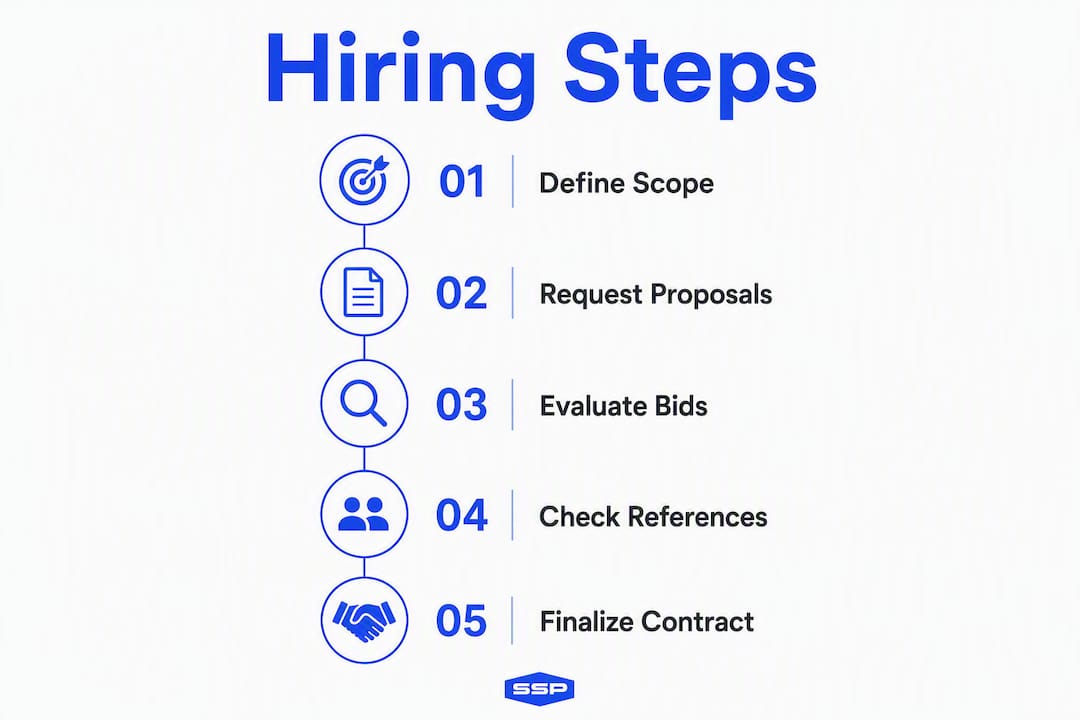
Commercial painting projects follow a structured five-phase cycle: assessment and proposal, procurement and mobilization, surface preparation, application, and inspection with a punch list. Surface preparation and application consume the largest share of both schedule and budget, and they are where long-term performance is won or lost.
Here is the phase-by-phase checklist a facility manager can use to track progress:
- Assessment and proposal — Contractor walks the site, documents substrate conditions, identifies repairs, and delivers a written scope with specified products and a phased schedule.
- Procurement and mobilization — Materials are ordered (lead times for specialty coatings can run two to four weeks), equipment is staged, and site logistics are confirmed with building management.
- Surface preparation — Cleaning, repair of cracks and spalls, priming, and any required substrate testing. This phase commonly drives 20–40% of total project time.
- Application — Primer and topcoat application in the specified number of coats, with recoat windows observed per manufacturer requirements.
- Inspection and punch list — Contractor and owner or facility manager walk the completed work, document deficiencies, and confirm all items are resolved before final payment is released.
"Surface preparation is the most critical durability factor; improper prep is the leading cause of premature coating failure." — Moorhouse Coating
During application, require the contractor to maintain environmental logs (temperature, humidity, dew point), perform adhesion tests on representative areas, and record wet and dry film thickness checks. Those records are not bureaucratic overhead — they are the documentary evidence that preserves your manufacturer warranty and gives you standing in any dispute.
Pro Tip: Build a checkpoint at the end of surface prep, before any primer goes down. A brief written sign-off at that stage costs nothing and prevents the most expensive argument in commercial painting: whether the substrate was properly prepared.
What determines the cost of a commercial painting project?
Per-square-foot estimates for commercial painting commonly range from $2 to $6, but that range is a starting point, not a budget. The actual number depends on six primary drivers: square footage, substrate condition and required repairs, access complexity, number of coats and primer requirements, coating performance class, and schedule or occupancy constraints.
| Cost Line Item | What Drives It |
|---|---|
| Mobilization | Travel, setup, site protection, temporary signage |
| Surface preparation | Extent of cleaning, patching, caulking, and priming |
| Materials | Coating class (standard, low-VOC, epoxy, urethane), custom colors, primer type |
| Labor | Crew size, hours, after-hours or weekend premium |
| Equipment rental | Scaffolding, aerial lifts, containment systems |
| Waste and disposal | Solvent disposal, lead-paint abatement if applicable |
| Permit fees | Varies by jurisdiction; confirm with local authority |
| Contingency | Typically 10% for hidden substrate damage or scope changes |
Specialty coatings — epoxy floor systems, urethane topcoats, intumescent fire-resistant coatings — carry higher material costs and sometimes longer lead times. Custom colors mixed to a proprietary formula add a modest premium and can extend procurement time. Both factors belong in your budget before you go to bid.
Pro Tip: Require line-item pricing in your RFP. A contractor who submits a single lump sum with no breakdown cannot be compared fairly to one who itemizes prep, materials, and labor separately. Low-ball bids almost always hide the omission of prep or inspection in an undifferentiated total.
How do surface preparation and coating selection affect service life?
Improper surface preparation is the leading cause of premature coating failure, and no premium topcoat compensates for a substrate that was not properly cleaned, repaired, and primed. A well-prepped surface extends coating life more reliably than upgrading paint quality alone. Understanding surface prep and priming is the foundation of any durable commercial finish.
Match your coating system to the environment:
- Occupied interior spaces — specify low-odor, low-VOC or zero-VOC waterborne coatings to protect indoor air quality and allow work during business hours
- Exterior facades — require UV-resistant, abrasion-resistant systems rated for the local climate; in coastal environments, salt resistance is a non-negotiable specification
- Floors and industrial areas — epoxy or polyurethane floor coatings for chemical resistance and durability under heavy traffic
- High-humidity areas (kitchens, restrooms, mechanical rooms) — moisture-resistant primers and mold-inhibiting topcoats
Primer selection follows substrate logic. Adhesion primers are required when painting over glossy or previously coated surfaces. Stain-blocking primers are necessary over water stains, smoke damage, or tannin-rich wood. For concrete substrates, moisture vapor emission testing or relative humidity testing should be performed before coating; steel surfaces need checks for oil contamination, soluble salts, and flash rust before any primer is applied.
Pro Tip: Include manufacturer name and product name in your RFP specifications — not just a generic description like "two-coat exterior latex." Named products make bids directly comparable, prevent substitution without approval, and give you a clear warranty chain back to the manufacturer.
How do you keep a building operational during a painting project?
Professional commercial painting contractors manage occupied sites with specialized equipment, strict safety protocols, and coordinated execution — but the facility manager's role in scheduling and communication is just as important as the contractor's execution. A commercial paint scheduling plan built before mobilization prevents most disruption complaints.
Practical strategies for occupied buildings:
- Phase by area or floor — complete one zone before moving to the next, so tenants always have access to unaffected spaces
- After-hours and weekend shifts for lobbies, corridors, and any space that cannot be vacated during business hours
- Temporary signage and traffic control to redirect foot traffic away from active work areas
- Tenant notices at least five business days before work begins in their area, with a point of contact for questions
- Weekly photo logs shared with building management to document progress and surface conditions
For odor and indoor air quality, low-VOC or zero-VOC coatings are the most effective control. Supplement with temporary ventilation — exhaust fans drawing air out of the work zone — and containment barriers to prevent overspray and dust migration into occupied areas. In multi-tenant retail or office buildings, coordinate with HVAC to avoid recirculating paint odors through shared air-handling systems.
When should you repaint, and how do you plan the budget?
Property managers should treat painting as a portfolio maintenance program, using a master coating inventory and a scheduled inspection cadence to extend repaint intervals and reduce unplanned capital spending. The distinction between maintenance painting and capital repaints matters for how you budget and how you account for the expense.
Maintenance painting (operating expense) covers turnover touch-ups, spot repairs, and minor repaints triggered by damage or wear. Capital repaints (capital expenditure) are full system replacements driven by coating failure, substrate deterioration, or a planned refresh cycle.
A practical multi-year program follows this sequence:
- Build a master coating inventory — record every painted surface, the coating system applied, the date of last repaint, and the expected service life.
- Annual visual inspection — walk every surface and note chalking, fading, cracking, peeling, or substrate damage.
- Quarterly cleaning — pressure washing or soft washing exterior surfaces removes contaminants that accelerate coating degradation.
- Touch-up triggers — establish written criteria (e.g., adhesion loss exceeding a defined area, visible rust bleed on steel) that automatically trigger a maintenance response before failure spreads.
- Capital repaint scheduling — align full repaints with lease renewals, seasonal weather windows, and portfolio-wide bundling opportunities.
Bundling multiple buildings or multiple surfaces into a single contract typically reduces per-unit cost and simplifies contractor management. For why regular paint maintenance matters to your property's long-term value, the logic is straightforward: a coating maintained in good condition lasts significantly longer than one that is allowed to fail before replacement.
What insurance, licensing, and safety documents should you require?
Verifying a contractor's compliance documents before award is not a formality — it is the primary mechanism for protecting the property owner from liability if a worker is injured on site or if the contractor causes property damage.
Insurance checklist:
- Commercial general liability (CGL) — confirm limits are appropriate for your project size and property value
- Workers' compensation — must cover all employees and any subcontractors working on the project
- Commercial auto — required if contractor vehicles operate on the property
- Additional-insured endorsement — the COI must name the property owner and, if applicable, the property management company
- Umbrella or excess liability — for large or complex projects, confirm the umbrella limit
Licensing and safety:
- Verify state contractor license and any local business license; ask for the license number and confirm it with the issuing agency
- Request the contractor's EMR from NCCI — below 1.0 is the standard threshold for acceptable safety performance
- Ask for the OSHA recordable incident rate for the past three years
- For industrial or specialty work, ask about SSPC/AMPP or NACE training for coating inspectors and applicators
Site safety plan for occupied buildings should include: fall protection procedures for any work above six feet, confined-space entry procedures if applicable, PPE requirements for all crew members, daily toolbox talks documented in writing, and a spill and emergency response plan.
How long does a commercial painting project typically take?
Calendar ranges for typical commercial painting projects vary considerably by project type, substrate condition, and occupancy constraints. Surface preparation alone commonly accounts for 20–40% of total project time, and recoat windows — the minimum time between coats specified by the manufacturer — are non-negotiable schedule drivers.
| Project Type | Typical Calendar Range |
|---|---|
| Small interior repaint | 1–2 weeks |
| Mid-size occupied interior | 3–6 weeks |
| Standard exterior building | 2–4 weeks |
| Parking garage (deck coatings + traffic markings) | 2–5 weeks |
| Industrial facility | 2–8 weeks depending on complexity |
Common schedule risks include weather delays for exterior work, hidden substrate damage discovered during prep, product lead times for specialty coatings, access equipment availability, and occupied-building constraints that limit working hours. Each of these can add days or weeks to the original schedule.
Acceleration options exist — additional crews, after-hours shifts, and fast-cure coating products — but each carries tradeoffs. More crews in a confined space can compromise quality and safety. After-hours work adds a labor premium. Fast-cure products sometimes sacrifice long-term durability for speed. Build realistic float into your schedule rather than relying on acceleration to recover lost time.
What should your RFP include, and what are the red flags?
A clear, line-item RFP is the single most effective tool for getting comparable bids and reducing change orders. Require manufacturer and product names, number of coats, cure windows, and explicit exclusions so every bidder prices the same scope of work.
RFP checklist:
- Scope-of-work line items by surface type and location
- Product specifications: manufacturer name, product name, and color system
- Surface prep standard: cleaning method, repair scope, primer type
- Number of coats and minimum dry film thickness per coat
- Recoat and cure windows per manufacturer data sheet
- Access and equipment plan: scaffolding, lifts, containment
- Phasing schedule with milestone dates
- Daily cleanup and site security requirements
- Waste disposal and solvent handling procedures
- Proof of insurance and EMR submitted with bid
Contract terms to require:
- Payment schedule tied to verified milestones, not calendar dates
- Retainage (typically 10%) held until punch list is complete and accepted
- Warranty language specifying coverage period, what is covered, and the response time for callbacks
- Change-order procedures: written authorization required before any out-of-scope work begins
- COI naming owner as additional insured, on file before mobilization
| Red Flag | What It Signals |
|---|---|
| Vague or missing exclusions | Hidden scope gaps that become change orders |
| No site visit before bid | Contractor is pricing blind; expect surprises |
| Refusal to provide COI or EMR | Compliance or safety problems |
| Lump-sum price with no line items | Cannot verify prep, materials, or inspection are included |
| Unusually low total price | Prep or inspection likely omitted; early failure probable |
What experience shows matters most in commercial painting
The gap between a technically adequate paint job and one that actually protects your asset for its full expected service life comes down to three things: documentation, surface preparation, and contractor accountability after the job is done.
Proper documentation — environmental logs, film thickness records, adhesion test results, and photo evidence at each phase — is what separates a contractor who stands behind their work from one who disappears after final payment. Manufacturer warranties are frequently voided by application conditions that were never recorded, leaving the property owner with no recourse.
Southshorepaint approaches commercial projects with documented processes at every phase: written condition assessments before proposal, specified products named in the contract, inspection checkpoints at the end of surface prep and after each coat, and a post-completion maintenance plan delivered with the final punch list. Measurable vetting signals — EMR, manufacturer certifications, inspection logs, and warranty terms — are the same criteria Southshorepaint uses to evaluate its own subcontractors and suppliers.
Pro Tip: Ask any contractor you are considering: "Can you show me your inspection log from a recent comparable project?" A contractor with a real quality process will have one. A contractor who looks puzzled by the question is telling you something important.
Key Takeaways
A successful commercial painting project requires a written scope, qualified contractor vetting, specified surface preparation, and a documented inspection process before any final payment is released.
| Point | Details |
|---|---|
| Do a condition assessment first | Walk every surface and document substrate condition before writing the RFP or inviting bids. |
| Require line-item pricing | Line-item bids expose omissions in prep and inspection that lump-sum bids conceal. |
| Verify insurance and EMR | Confirm COI with additional-insured endorsement and request EMR below 1.0 from NCCI. |
| Specify products and prep standards | Name the manufacturer and product in the RFP; require written prep standards and film thickness records. |
| Phase work for occupied buildings | Build a written phasing plan with tenant notices, after-hours shifts, and low-VOC coatings for occupied spaces. |
| Southshorepaint for South Bay projects | Southshorepaint delivers documented commercial painting with specified materials, inspection checkpoints, and a post-completion maintenance plan. |
What the standard advice on commercial painting gets wrong
Most guides on hiring a commercial painting contractor spend the bulk of their space on insurance checklists and bid comparison tables. Those things matter, but they are not where projects actually fail. Projects fail at surface preparation — specifically, at the moment when a contractor and a facility manager both know the prep is incomplete but nobody wants to delay the schedule to fix it.
The pressure to stay on timeline is real, especially in occupied buildings where tenants are already inconvenienced. But a coating applied over inadequately prepared concrete or steel will begin failing within one to three years, often voiding the manufacturer warranty in the process. The cost of that early failure — materials, labor, access equipment, and tenant disruption a second time — dwarfs whatever was saved by skipping two days of additional prep work.
The other thing most guides understate is the value of the post-completion maintenance plan. A contractor who delivers a written maintenance schedule, with inspection triggers and recommended touch-up intervals, is demonstrating that they understand coating systems as a long-term investment rather than a one-time transaction. That document also gives the property team a defensible basis for capital budget requests: "The coating system installed in 2024 has an expected service life of eight to ten years with annual cleaning and spot repair; the next capital repaint is projected for 2032."
Treat the maintenance plan as a required deliverable, not an optional add-on. If a contractor does not offer one, ask for it. If they cannot produce one, that tells you something about how they think about the work they just completed.
South Shore Painting handles commercial projects from scope to punch list
Property teams in the South Bay, CA who want a commercial painting contractor that prices honestly, preps properly, and documents everything have a direct option in Southshorepaint.

Southshorepaint handles the full scope of commercial painting work: interior and exterior painting for office, retail, and multi-family properties; drywall repair and substrate preparation; cabinet refinishing; specialty floor coatings; and ongoing maintenance programs for property portfolios. Every project starts with a written condition assessment and a line-item proposal that names the products, specifies the prep standard, and lays out a phasing plan designed to keep your building operational.
For occupied buildings, Southshorepaint coordinates after-hours scheduling, low-VOC coating selection, and tenant communication as standard practice, not an upgrade. The process ends with a documented punch list and a written maintenance plan.
Request a site visit and estimate to get a scoped proposal for your property.
Useful sources and further reading
The sources below are worth bookmarking for deeper research on contractor vetting, cost benchmarks, and project timelines.
- How Long Does Commercial Painting Take? — Moorhouse Coating Blog — Detailed breakdown of phase-by-phase schedule drivers and realistic calendar ranges by project type; useful for setting timeline expectations before you go to bid.
- Contractor Selection: How to Choose the Right Commercial Painting Partner — Moorhouse Coating Blog — Covers RFP structure, total cost of ownership evaluation, and what a well-structured proposal should contain.
- The Complete Guide to Commercial Building Painting — Moorhouse Coating Blog — Thorough treatment of surface preparation requirements, substrate testing, and coating selection for facility managers.
- The Property Manager's Guide to Commercial Painting — Moorhouse Coating Blog — Focused on multi-year maintenance planning, master coating inventories, and portfolio bundling strategies.
- Commercial Painting Cost Guide — HomeGuide — Per-square-foot cost benchmarks with breakdowns by project type; useful as a sanity check when reviewing bids.
- NCCI — Experience Modification Rate — The authoritative source for understanding EMR calculations and what the metric means for contractor safety performance.
- How Commercial Painting Contractors Work — World Pro Painting Blog — Practical overview of how professional contractors manage equipment, safety protocols, and occupied-site coordination.
- High-Rise Painting Guide for Commercial Property Managers — CCR Magazine — Covers access logistics, coating compliance, and repaint cycle decisions specific to mid-rise and high-rise properties.
- Painting Contractors Association (PCA) — Industry association for professional painting contractors; useful for finding credentialed contractors and understanding industry standards.