
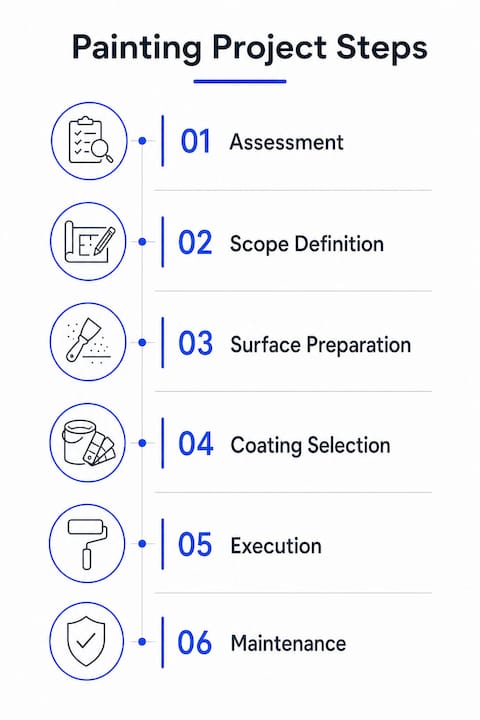
Commercial painting is defined as the systematic application of protective and decorative coatings to business facilities, covering everything from office interiors to industrial exteriors. Knowing how to paint commercial spaces correctly separates a durable, professional finish from a costly repaint two years later. The process demands more than brushes and rollers. It requires a condition assessment, surface preparation that meets SSPC and ASTM standards, coating selection matched to the service environment, phased execution that keeps your facility running, and a documented maintenance program. Southshorepaint builds every commercial project on these principles, because proper prep and premium materials are the only way to make results last.
How to paint commercial spaces: assessment and planning essentials
Every successful commercial painting project starts with a written condition assessment, not a phone call to a contractor. Walk the facility and document peeling, corrosion, staining, efflorescence, and substrate types before anyone picks up a brush. Photographs with timestamps give you an objective baseline and protect you during contractor negotiations.
Scope definition comes next. Decide whether you need a full repaint, a zone-by-zone refresh, or targeted touch-ups on high-traffic corridors. Vague scopes produce vague bids. Standardized RFQ templates with line-item pricing reduce change orders and let you compare contractors on equal terms, because each bidder must disclose labor, materials, equipment, and scheduling assumptions separately.

Operational constraints shape your timeline as much as the painting itself. A hospital corridor, a retail floor, and a warehouse have very different tolerance for fumes, noise, and blocked access. Map out which zones can be taken offline and when, then build a phasing plan around those windows. Climate matters too. High humidity slows cure times and compromises adhesion, so schedule exterior work during dry, moderate-temperature periods.
| Prerequisite | Details |
|---|---|
| Condition assessment | Document substrate type, defects, and contamination before bidding |
| Scope definition | Specify zones, surfaces, and finish requirements in writing |
| Operational phasing | Identify which areas can be closed and for how long |
| Contractor RFQ | Use line-item format to compare labor, materials, and assumptions |
| Climate check | Confirm temperature and humidity fall within coating manufacturer specs |
Pro Tip: Photograph every defect and include the images in your RFQ package. Contractors who see documented conditions give more accurate bids and have fewer grounds for change orders.
What does proper surface preparation actually involve?
Surface preparation is the largest variable affecting paint durability. Inadequate prep causes premature coating failure regardless of how expensive the paint is. That statement is not a warning. It is the single most important fact in commercial painting.
Preparation methods vary by substrate. Drywall typically needs cleaning, light sanding, and a PVA primer. Concrete requires pressure washing, acid etching or abrasive profiling, and a penetrating masonry primer to prevent alkali attack. Metal surfaces demand rust removal, abrasive blasting or mechanical sanding to the correct SSPC surface profile, and an anti-corrosive primer. Stucco needs moisture testing before any coating goes on, because trapped moisture causes blistering and delamination within months.
Moisture testing is non-negotiable on any masonry or concrete substrate. A moisture meter reading above the coating manufacturer's threshold means the surface is not ready, regardless of how dry it looks. Chemical contamination, oil residue, and form-release agents on concrete also prevent adhesion and must be removed with appropriate degreasers before priming.
| Surface | Prep method | Suitable primer |
|---|---|---|
| Drywall | Clean, sand, fill holes | PVA drywall primer |
| Concrete | Pressure wash, acid etch or abrasive profile | Penetrating masonry primer |
| Metal | Abrasive blast or mechanical sand to SSPC profile | Anti-corrosive epoxy primer |
| Stucco | Moisture test, clean, repair cracks | Alkali-resistant masonry primer |
Pro Tip: Require your contractor to provide a written inspection checklist at each prep stage. If they resist, that tells you something important about how they work.
Choosing the right paint and coatings for commercial spaces
Coating selection is not about picking a color from a fan deck. Industry standards match coating technologies to the service environment: 100% acrylic latex for flexible exterior surfaces, epoxy or scuff-resistant acrylics for high-traffic interiors, and anti-corrosive systems for steel structures. Applying the wrong coating to the right surface is as costly as skipping prep entirely.
Low-VOC coatings deserve serious consideration in occupied facilities. They reduce chemical exposure for employees and tenants, and they accelerate re-occupancy after application. Performance has improved significantly, and most commercial-grade low-VOC products now match the durability of conventional coatings. For offices and healthcare environments, this is the default choice, not an upgrade.
Finish selection affects both durability and maintenance. Semi-gloss and satin finishes resist scrubbing, clean easily, and hold up in corridors, restrooms, and kitchens. Flat finishes hide surface imperfections but absorb stains and are difficult to clean. Reserve flat finishes for low-traffic ceilings and executive offices where walls rarely take impact.
Color selection in commercial spaces carries functional weight beyond branding. Lighter colors make smaller spaces feel larger and reduce lighting costs. High-contrast accent walls guide foot traffic in large facilities. For choosing colors for commercial spaces, consider how the color reads under your specific lighting type, because fluorescent, LED, and natural light all shift perceived hue.
Key factors that drive coating selection:
- Traffic level: High-traffic zones need scuff-resistant, washable finishes
- Moisture exposure: Restrooms, kitchens, and exterior surfaces need moisture-resistant coatings
- Substrate type: Each substrate requires a chemically compatible primer and topcoat
- Occupancy during work: Low-VOC products protect occupants and speed re-entry
- UV exposure: Exterior coatings need UV-stable pigments to prevent fading and chalking
- Regulatory requirements: Some facilities require antimicrobial or fire-retardant coatings
How do you execute a commercial painting project with minimal disruption?
Execution without a phasing plan creates unnecessary friction. Dividing the facility into zones and notifying tenants or staff at least two weeks in advance sets clear expectations and reduces complaints. Scheduling painting in off-hours or on weekends protects productivity for office environments and keeps retail spaces operational during peak hours.
Painting-related falls account for over 30,000 injuries annually in construction. OSHA-compliant fall protection, proper scaffolding, and containment procedures are mandatory, not optional. Verify that your contractor carries current liability insurance and workers' compensation coverage before work begins.
Communication is the most underrated part of execution. Proactive communication and clearly defined roles between facility managers and contractors minimize disruptions in occupied facilities. Designate a single point of contact on both sides and establish a daily check-in routine. Daily five-minute check-ins between the facility manager and crew keep the schedule on track and surface problems before they become delays.
A numbered execution sequence keeps quality consistent across zones:
- Confirm zone is cleared, protected, and prep-inspected before coating begins
- Apply primer coat and allow full cure per manufacturer specifications
- Inspect primer for holidays, thin spots, or adhesion failures before topcoat
- Apply first topcoat and document wet film thickness at regular intervals
- Inspect first topcoat under raking light before applying second coat
- Conduct final walkthrough with contractor, document deficiencies, and set a punch-list deadline
For detailed commercial paint scheduling strategies that protect operational continuity, Southshorepaint has published a property manager's guide covering zone sequencing and tenant communication templates.
Maintaining commercial paint for longevity and appearance
Commercial interiors typically need repainting every 5–10 years, with high-traffic areas requiring touch-ups every 1–3 years and full repaints every 3–5 years. That cycle is not arbitrary. It reflects how quickly abrasion, UV exposure, and cleaning chemicals degrade coating integrity in active facilities.
Touch-ups have a functional limit. Widespread fading or patchy repairs require a full repaint to maintain a professional appearance. Mixing old and new paint creates visible patches under varied lighting conditions, which signals neglect to clients and visitors regardless of how clean the space is otherwise.
Documenting your coating system is the single most practical step facility managers overlook. Record the brand, product line, color name, color code, sheen level, and batch number for every surface. This record makes future touch-ups accurate and prevents the mismatched repairs that force premature full repaints.
A maintenance program built around regular inspection and cleaning extends paint life significantly:
- Inspect walls quarterly for scuffs, stains, and early delamination
- Clean painted surfaces with pH-neutral cleaners to avoid stripping sheen
- Address moisture intrusion at the source before repainting affected areas
- Schedule touch-ups proactively rather than waiting for visible deterioration
- Review your coating records annually and update them after any repair work
For more on long-term paint maintenance and how to build a property-specific inspection schedule, Southshorepaint's maintenance guide covers the full cycle from first coat to full repaint decision.
Key Takeaways
Effective commercial painting requires systematic preparation, correct coating selection, phased execution, and documented maintenance to protect your facility as a long-term asset.
| Point | Details |
|---|---|
| Prep determines durability | Surface preparation failure is the leading cause of premature coating failure, regardless of paint quality. |
| Match coatings to environment | Use acrylic latex for exteriors, epoxy for high-traffic interiors, and anti-corrosive systems for metal. |
| Phase work to protect operations | Divide the facility into zones and notify occupants at least two weeks before work begins. |
| Document everything | Record brand, product, color code, and sheen for every surface to enable accurate future repairs. |
| Plan maintenance proactively | High-traffic areas need touch-ups every 1–3 years; full repaints every 3–5 years to maintain appearance. |
Why I treat commercial painting as asset management, not cosmetics
The most expensive mistake I see facility managers make is treating a painting project as a one-time cosmetic fix rather than part of a long-term asset protection program. When painting is reactive, you end up repainting the same wall three times in ten years because the underlying moisture problem was never addressed, or because the contractor used the wrong primer on a concrete substrate and the coating failed in eighteen months.
The second mistake is selecting contractors based on the lowest bid without requiring line-item pricing. A low number on a single-line quote almost always means something was excluded. Prep hours are the first thing to disappear from a cheap bid, and prep is exactly where durability is won or lost.
What actually works is treating the condition assessment as a formal document, requiring contractors to respond to it with itemized proposals, and holding weekly or daily check-ins during execution. Transparent communication is not a soft skill in this context. It is a project management tool that prevents the kind of scope creep and schedule slippage that turns a two-week project into a six-week disruption.
The facilities I have seen maintain the best appearance over time are the ones where the facility manager keeps a coating log. They know exactly what product is on every wall, when it was applied, and when the next inspection is due. That discipline is what separates a building that looks sharp at year eight from one that looks tired at year three.
— Ryan
Southshorepaint's commercial painting expertise
Southshorepaint specializes in commercial and residential painting built on proper preparation, premium materials, and workmanship designed to last. Whether you manage a single office suite or a multi-building campus, the team at Southshorepaint brings the same systematic approach to every project: documented prep, coating selection matched to your environment, and execution that respects your operational schedule.

Facility managers working with Southshorepaint get more than a paint crew. They get a partner who understands coating systems, substrate requirements, and the real cost of cutting corners on prep. Explore commercial painting services from Southshorepaint and connect with a team that treats your building as the long-term asset it is.
FAQ
What is the difference between commercial and residential painting?
Commercial painting covers larger, more complex facilities with stricter durability, safety, and scheduling requirements than residential work. It involves industrial-grade coatings, OSHA compliance, and phased execution to keep businesses operational during the project.
How often should commercial spaces be repainted?
High-traffic commercial interiors need touch-ups every 1–3 years and full repaints every 3–5 years. Exterior surfaces and lower-traffic areas typically follow a 5–10 year repaint cycle depending on climate and coating type.
What is the best paint for office spaces?
100% acrylic latex in a satin or semi-gloss finish is the standard choice for office interiors. Low-VOC formulations are preferred in occupied spaces because they reduce chemical exposure and allow faster re-occupancy after application.
How do I minimize disruption during a commercial painting project?
Divide the facility into zones, schedule work during off-hours or weekends, and notify occupants at least two weeks in advance. Assign a single point of contact on both sides and conduct daily check-ins to keep the project on schedule.
Why does surface preparation matter so much in commercial painting?
Surface preparation is the primary factor determining how long a coating lasts. Inadequate cleaning, moisture testing, or profiling causes premature adhesion failure regardless of the paint quality applied on top.