
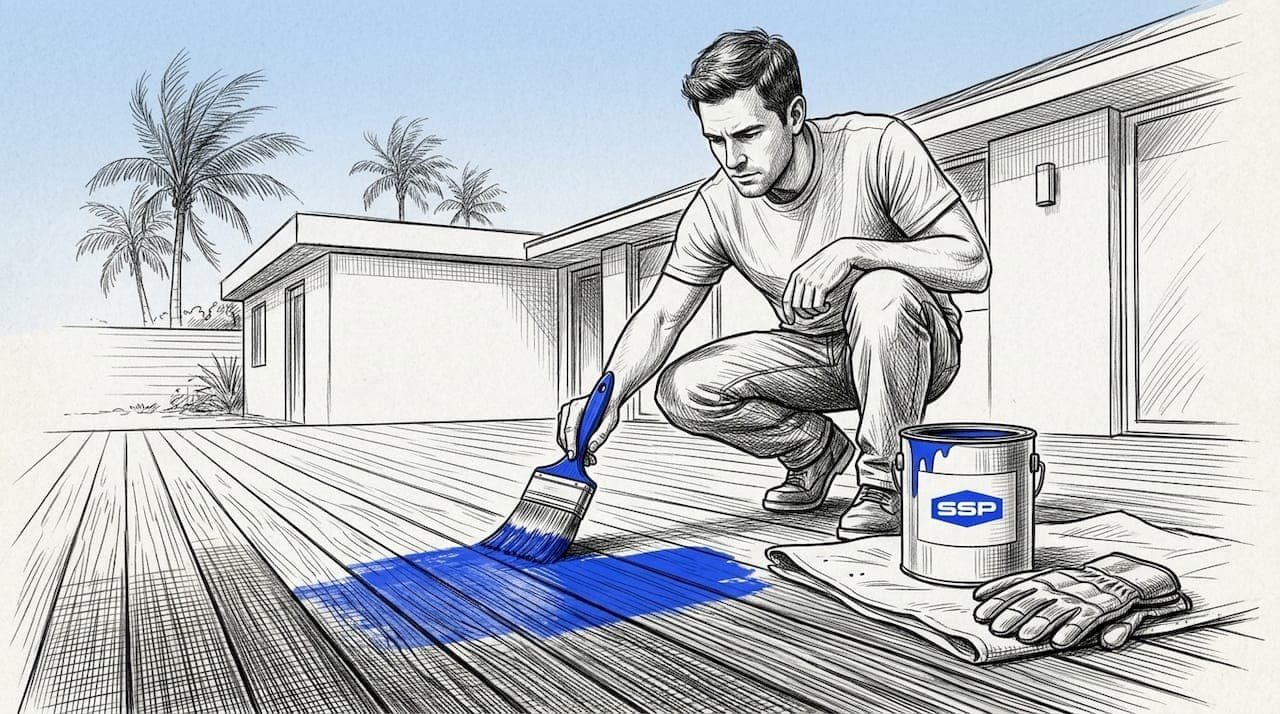
Deck painting services are defined as professional surface preparation, priming, and coating applications designed to protect and beautify outdoor wood or composite decking. For South Bay, CA homeowners, the coastal sun, salt air, and temperature swings make this more than a cosmetic upgrade. It is a structural investment. This guide covers what professional deck painting includes, how to choose the right products for the local climate, what it costs, when to schedule the work, and how to avoid the mistakes that cause early failure. Whether you are refreshing a weathered surface or restoring a neglected deck, understanding the full process helps you hire smarter and get results that last.
What do professional deck painting services include?
Professional deck painting is not simply rolling paint onto boards. The industry term for the full scope is deck refinishing, and it encompasses preparation, repair, priming, and finish coating as a single integrated workflow. Skipping any stage compromises the entire result.
Here is the standard process a qualified contractor follows:
- Sweep and clear the deck surface. All furniture, planters, and debris are removed before any work begins. Loose dirt and organic material must be cleared before chemical cleaning.
- Apply deck cleaner and pressure wash. A commercial-grade deck cleaner loosens mildew, grease, and oxidized wood fibers. The professional prep workflow calls for rinsing with a pressure washer after the cleaner has had time to penetrate.
- Allow 48 hours of drying time. Painting over damp wood is one of the leading causes of bubbling and peeling. Professionals build this drying window into the project schedule, not around it.
- Sand, scrape, and feather old paint. Any loose, flaking, or peeling paint is removed mechanically. Edges are feathered so the new coat bonds smoothly without ridges.
- Repair or replace damaged boards. Soft, cracked, or rotted boards are addressed before painting. Coating over structural damage only hides the problem temporarily.
- Prime bare wood. Any exposed wood receives an exterior-grade primer before the finish coat. Skipping primer on bare wood causes uneven absorption and early adhesion failure.
- Apply two thin finish coats. Two thin coats outperform one thick coat in every measurable way: better adhesion, more uniform color, and longer service life.
- Detail railings, posts, and edges. These areas require brush work rather than roller application. Professionals treat them as separate surfaces, not afterthoughts.
Pro Tip: Ask your contractor specifically how they handle the underside of deck boards and the base of posts. These are the spots most likely to trap moisture and fail first, and they are frequently skipped by less experienced crews.
Recoat windows typically run 4 to 6 hours between coats, with the surface dry to the touch within 1 to 2 hours. That timeline sounds fast, but full cure takes considerably longer, which matters for how soon you can use the deck.
How to select the right paint and products for your deck
Product selection for a South Bay deck is not a generic decision. The combination of intense UV exposure, marine humidity, and foot traffic demands coatings built specifically for those conditions.
The three main categories you will encounter are:
- Deck paint creates an opaque film over the wood surface. It hides grain and color variation, offers strong UV resistance, and works well on older decks where appearance consistency matters more than showing the wood's natural character.
- Deck stain penetrates the wood rather than sitting on top. Solid-color stains behave similarly to paint in terms of coverage, while semi-transparent stains preserve more of the wood grain. Deck staining services using penetrating formulas tend to peel less over time because there is no surface film to crack.
- Specialty coatings occupy a distinct category. Behr DeckOver, for example, sits between paint and stain in formulation. It fills hairline cracks, creates a textured non-slip surface, and is rated to last 5 to 10 years with proper prep and two-coat application. It is particularly useful for decks with minor surface checking that would telegraph through standard paint.
When evaluating products for South Bay conditions, prioritize these properties:
- UV resistance. Direct sun degrades binders in standard exterior paint faster than most manufacturers' labels suggest for coastal California conditions.
- Foot-traffic durability. Look for coatings labeled specifically for horizontal deck surfaces, not just exterior walls. High-quality paint products formulated for decks contain harder resins than standard exterior wall paint.
- Primer compatibility. Not every finish coat bonds well to every primer. Confirm that your contractor is using a primer and finish from the same product line or has verified compatibility.
- Appearance vs. protection tradeoff. Semi-transparent stains show more wood character but require more frequent reapplication. Solid coatings protect longer but commit you to an opaque finish going forward.
The product selection decision should be driven by the current condition of your deck, not just aesthetic preference. A deck with significant surface damage needs a filling, film-forming product. A structurally sound deck with good wood can benefit from a penetrating stain.
What factors influence the cost of professional deck painting in South Bay?
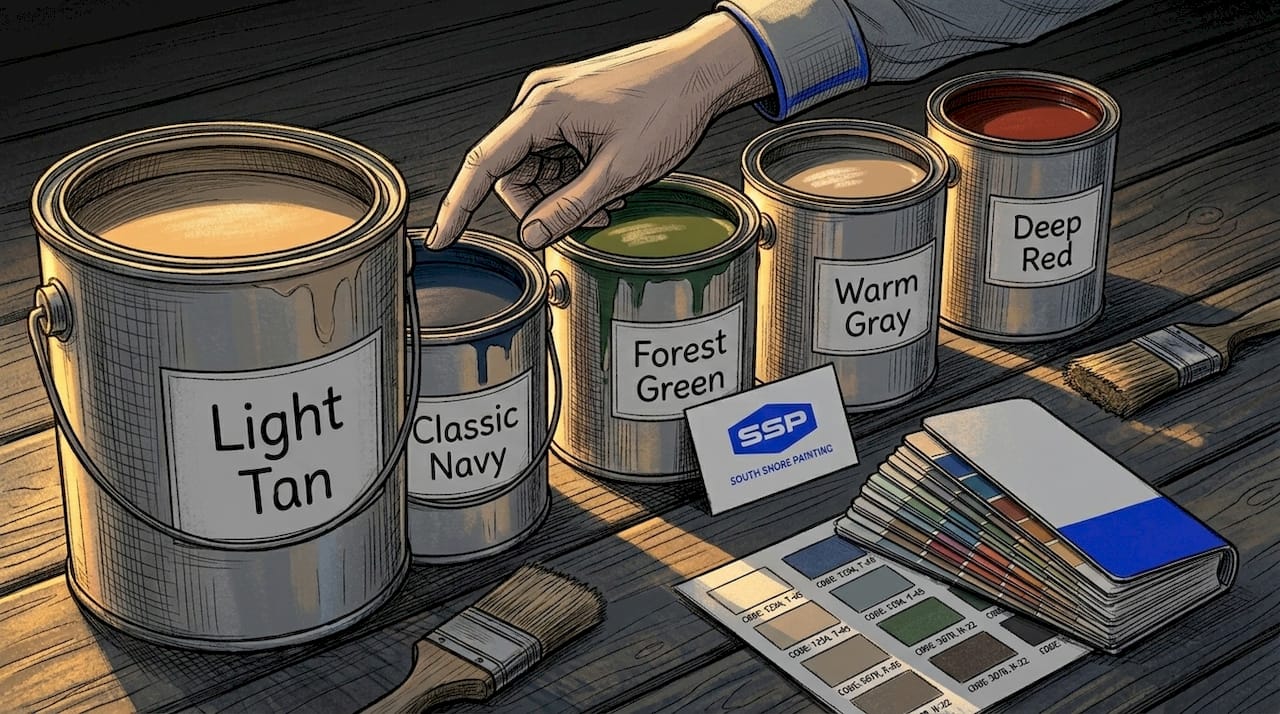
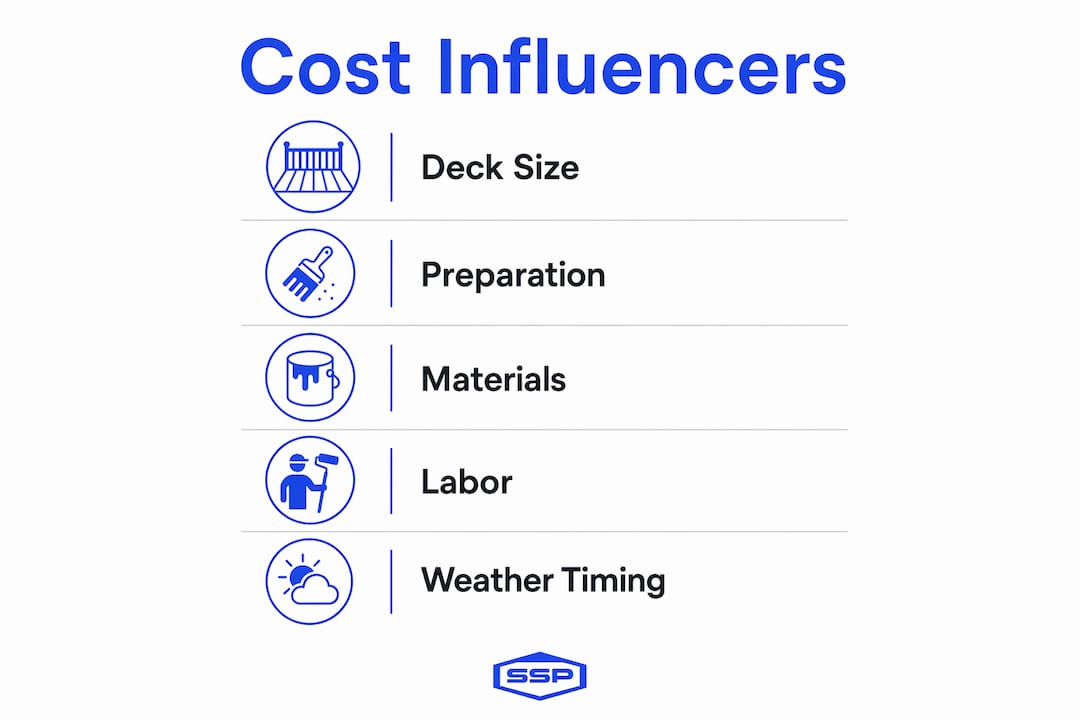
Understanding what drives pricing helps you evaluate quotes accurately and avoid being surprised mid-project.
| Cost Factor | Typical Impact |
|---|---|
| Deck size (sq ft) | Base cost scales directly; professional deck painting runs $2.50 to $6.50 per square foot |
| Surface condition | Heavy peeling, staining, or mildew adds prep labor and time |
| Repairs needed | Board replacement, fastener work, or structural fixes are billed separately |
| Detailing complexity | Railings, balusters, and stairs require brush work and add hours |
| Product selection | Specialty coatings like Behr DeckOver cost more per gallon than standard paint |
| Cleanup and protection | Masking adjacent surfaces, protecting landscaping, and disposal are included in full-service quotes |
Total project costs for professional outdoor deck restoration typically fall between $500 and $2,200, with most mid-size South Bay decks landing in the $800 to $1,400 range depending on condition and complexity. A deck that has been neglected for years will cost more to prepare than one that received regular maintenance.
DIY deck painting appears cheaper on the surface. Materials alone for a 300-square-foot deck might run $150 to $300. But the cost of renting a pressure washer, buying a sander, purchasing primer and finish coats, and accounting for the time investment narrows that gap considerably. More importantly, wood decks require repainting every 5 to 10 years, and a poorly executed DIY job often fails in 2 to 3 years, requiring a full strip and redo.
Pro Tip: When comparing quotes, ask each contractor to itemize preparation separately from materials and application. A low total quote that buries prep into a vague line item is often a sign that prep will be rushed.
When is the best time to schedule professional deck painting?
Timing a deck painting project is not just about convenience. Environmental conditions directly determine how well the paint bonds and how long it lasts. South Bay's climate is generally favorable, but specific windows matter.
The ideal painting conditions are a temperature range of 50 to 85°F, low relative humidity, and no rain in the forecast for at least 24 hours after application. Here is what that means practically for South Bay homeowners:
- Late spring and early fall are the best seasons. Summer in South Bay can push surface temperatures well above air temperature, especially on south-facing decks. Painting in direct, intense midday sun causes the paint to skin over before it properly bonds.
- Morning application is preferred. Cooler morning temperatures and lower humidity give the coating time to set before afternoon heat arrives.
- Avoid the marine layer window. South Bay's coastal fog can deposit moisture on surfaces even when it is not technically raining. Professionals check surface moisture with a meter, not just by feel.
- Plan for a 7 to 14 day cure period. The deck may be dry to the touch in 1 to 2 hours and ready for light foot traffic in 24 hours, but full cure takes 7 to 14 days. Moving furniture back too early or allowing heavy use before full cure causes scuffing and surface damage that looks like a product failure.
- Check the extended forecast, not just the day of. Rain within 24 hours of application can wash uncured paint off the surface entirely.
Understanding how weather shapes exterior paint jobs in this region is something experienced local contractors factor into their scheduling automatically. It is a meaningful advantage over hiring a crew that works primarily inland.
Common mistakes that shorten deck paint life
The most expensive deck painting mistake is not choosing the wrong color. It is rushing preparation or applying product in the wrong conditions. Durability depends most on surface preparation, product selection, and application technique, in that order.
The most common failure points are:
- Painting over damp wood. Moisture trapped beneath the coating has nowhere to go. It pushes the film off the surface, causing bubbling and blistering within months.
- Skipping primer on bare wood. Bare wood absorbs finish coats unevenly, leading to thin spots, color variation, and early adhesion failure.
- Applying one thick coat instead of two thin ones. Thick coats trap solvents as they dry, which creates soft spots and reduces long-term hardness.
- Painting in direct sun or high heat. The surface temperature of a sun-exposed deck can exceed 100°F on a warm South Bay afternoon. Paint applied to a hot surface dries too fast to bond properly.
- Neglecting edges, undersides, and rail bases. These areas are the first to fail because they are the most exposed to moisture and the least likely to be coated thoroughly by an inexperienced crew.
"The difference between a deck paint job that lasts three years and one that lasts eight is almost entirely in the preparation. The paint itself is almost secondary."
Professional deck painting services prevent these failures through process discipline, not just skill. A crew that follows a documented prep checklist, uses calibrated moisture meters, and applies product within manufacturer-specified temperature windows will consistently outperform one that relies on judgment alone.
Key takeaways
Professional deck painting services deliver lasting results only when preparation, product selection, and application timing are treated as equally important as the finish coat itself.
| Point | Details |
|---|---|
| Prep is the foundation | Pressure washing, drying 48 hours, and repairing boards before any coating is applied. |
| Product choice matters | Match the coating type (paint, stain, or specialty) to your deck's current condition and climate. |
| Cost ranges are predictable | Expect $2.50 to $6.50 per square foot; prep complexity and repairs are the main variables. |
| Timing affects durability | Paint between 50 and 85°F, avoid direct sun, and allow 7 to 14 days for full cure. |
| Mistakes are mostly avoidable | Damp wood, skipped primer, and thick coats cause most early failures in deck refinishing. |
What I've learned about deck painting in South Bay after years on the job
After working on decks across the South Bay, from Torrance to Redondo Beach to Manhattan Beach, the pattern I see most often is homeowners who invested in quality paint but skipped the preparation. The product gets blamed, but the prep was the problem.
The South Bay climate is genuinely demanding on exterior coatings. The UV intensity here is not the same as it is in the Valley or further inland. Salt air accelerates oxidation. And the marine layer creates moisture conditions that are easy to underestimate if you are not checking surface readings before you start. These are not reasons to avoid painting your deck. They are reasons to hire someone who accounts for them.
One thing I tell every homeowner before we start: read the quote carefully and look for what it says about preparation. A quote that lists "prep" as a single line item with no description is a red flag. Prep is where the time goes. It is where the money goes. And it is where the job either succeeds or fails before a drop of finish coat is applied.
Regular maintenance also extends the life of any professional job significantly. A light cleaning each year and a spot touch-up every two to three years can push a well-done deck refinishing from seven years to ten or more. That math makes professional deck painting services one of the better investments you can make in your outdoor space.
— Ryan
Get a professional deck estimate from Southshorepaint
If your deck is showing peeling paint, gray weathered wood, or surface damage from years of South Bay sun and salt air, Southshorepaint can help you restore it properly.

Southshorepaint is a professional residential painting company serving the South Bay with a focus on high-quality, long-lasting results. Every deck project starts with a thorough prep assessment, uses premium exterior coatings matched to local climate conditions, and is executed by crews who understand the difference between a paint job that looks good on day one and one that holds up for years. Visit Southshorepaint to request a free estimate and get a detailed scope of work before any commitment.
FAQ
How often should a wood deck be repainted?
Wood decks require repainting every 5 to 10 years depending on sun exposure, foot traffic, and how well the original job was prepared. Decks in high-UV coastal environments like South Bay may need attention closer to the 5-year mark.
What is the difference between deck paint and deck stain?
Deck paint forms an opaque film on the surface and hides wood grain, while deck stain penetrates the wood and preserves more of its natural appearance. Solid stains behave similarly to paint in coverage but tend to peel less because there is no surface film to crack.
How long does a professional deck paint job take to cure?
The surface is dry to the touch in 1 to 2 hours and ready for light foot traffic within 24 hours, but full cure takes 7 to 14 days. Placing furniture or allowing heavy use before full cure risks scuffing and surface damage.
Can I paint my deck myself to save money?
DIY deck painting is possible, but the preparation requirements are the same as professional work. Skipping or rushing prep to save time produces a finish that fails in 2 to 3 years instead of 7 to 10, making the apparent savings short-lived.
What should I look for when hiring a deck painting contractor?
Look for a contractor who itemizes preparation separately in the quote, specifies the products they will use, and can explain their process for checking surface moisture before application. A detailed scope of work is a reliable indicator of professional standards. Reviewing what separates professional painters from inexperienced crews helps you ask the right questions before signing anything.