

Hiring a professional painter for a typical U.S. home runs between a few thousand dollars to over ten thousand depending on scope, with interior-only and exterior-only projects varying widely in cost. A full interior-plus-exterior repaint on a 2,500 sq ft home averages $9,899 nationally in 2026, with a typical range of $9,060 to $11,984 according to TheFatBook's cost index. Those numbers shift meaningfully based on six primary factors:
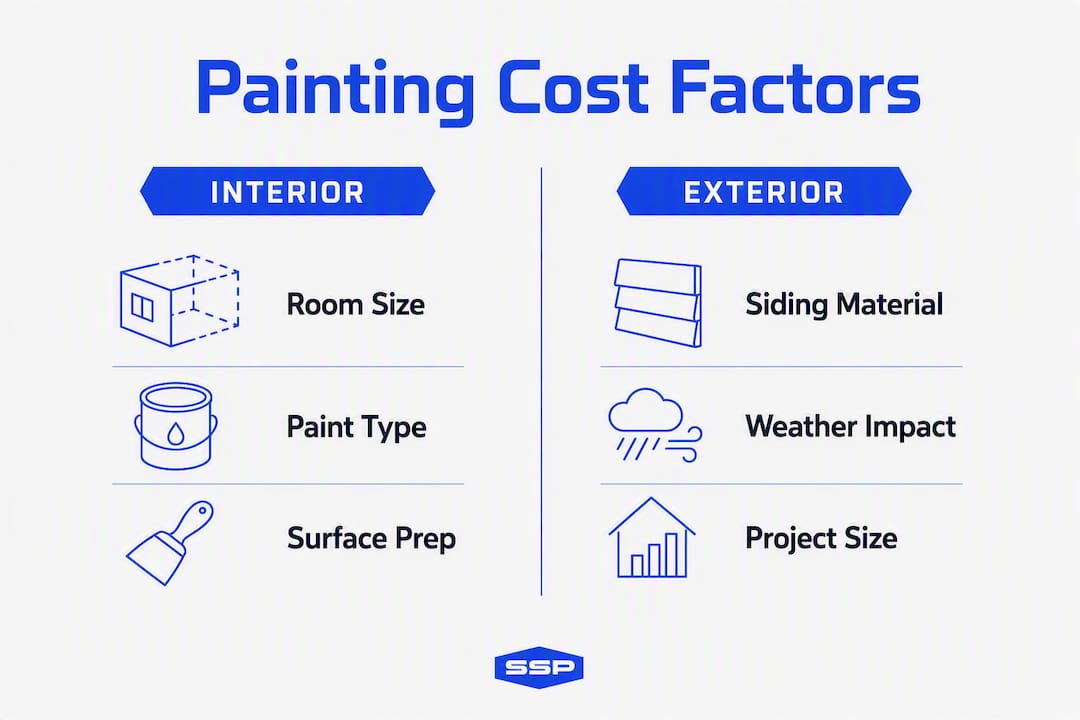
- Scope: Interior vs. exterior vs. combined determines crew size, equipment, and total hours.
- Surface prep and repairs: Patching, sanding, caulking, and priming can account for 30–50% of total labor hours and are the single largest variable in any quote.
- Paint grade and coat count: Premium paints cost more per gallon but often reduce the number of coats needed and extend finish life.
- Access and height: Two-story homes, steep rooflines, and dormers require ladders, lifts, or scaffolding that add both time and equipment cost.
- Regional labor rates: Metro markets like New York run significantly higher than lower-cost metros like San Antonio, per the same TheFatBook index.
- Special requirements: Homes built before 1978 may require EPA RRP lead-safe protocols, which add containment, labor, and disposal costs that can surprise homeowners who don't ask about them upfront.
Understanding where your home falls on each of these axes is the fastest way to evaluate whether a bid is realistic or suspiciously low.
Table of Contents
- How much does interior painting cost per room and per square foot?
- What does exterior painting cost for a typical house?
- How does a professional painting estimate break down?
- Sample project estimates: what real jobs actually cost
- How do painters quote jobs, and which pricing model is fairest?
- What should a written estimate include, and how do you vet the contractor?
- Practical ways to lower your painting bill without shortening the finish life
- How long does a professional painting project take?
- Key Takeaways
- Why the cheapest bid is almost never the best value
- What to expect from a Southshorepaint estimate
- Useful sources and verification links
How much does interior painting cost per room and per square foot?
Interior painting is typically quoted at rates that vary per square foot for walls only and higher rates when walls, trim, and ceilings are included, based on 2026 benchmarks from FacadeColorizer. Per-room pricing is common for smaller scopes, and most contractors apply a minimum charge for any job regardless of size, since setup, protection, and travel are fixed costs that don't scale down.
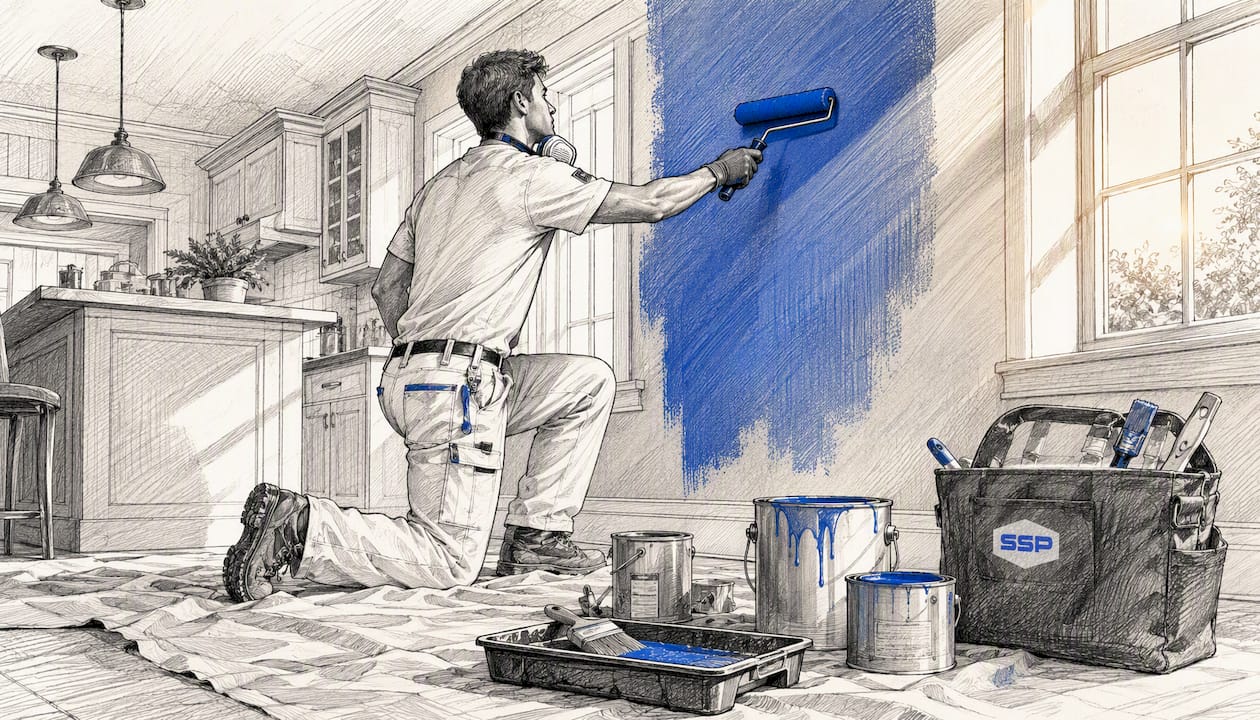
What's typically included in a standard interior repaint: two coats of finish paint, light surface prep (filling nail holes, light sanding), and masking of trim and fixtures. Significant patching, skim coating, or priming over dark colors usually appear as separate line items, and homeowners should expect them to be called out explicitly rather than bundled vaguely into a base price.
| Space | Typical Size | Walls Only | Walls + Trim + Ceiling |
|---|---|---|---|
| Small bedroom | 10×10 ft | $200–$400 | $400–$700 |
| Standard bedroom | 12×12 ft | — | — |
| Kitchen | 10×12 ft | — | — |
| Full interior (2,000 sq ft) | Whole house | — | — |
Small jobs carry a disproportionately high effective cost per square foot precisely because setup, drop cloths, and travel don't shrink with the job. A single accent wall quoted at $400 may look expensive against a $3/sq ft average, but the minimum charge is real and consistent across the industry.
What does exterior painting cost for a typical house?
Exterior painting typically runs a modest amount per square foot of paintable surface area, with NerdWallet's 2026 guide placing national averages in a similar range. For whole-house projects, pricing varies by home size and complexity, with single-story smaller homes costing less than larger two-story homes before any repairs.
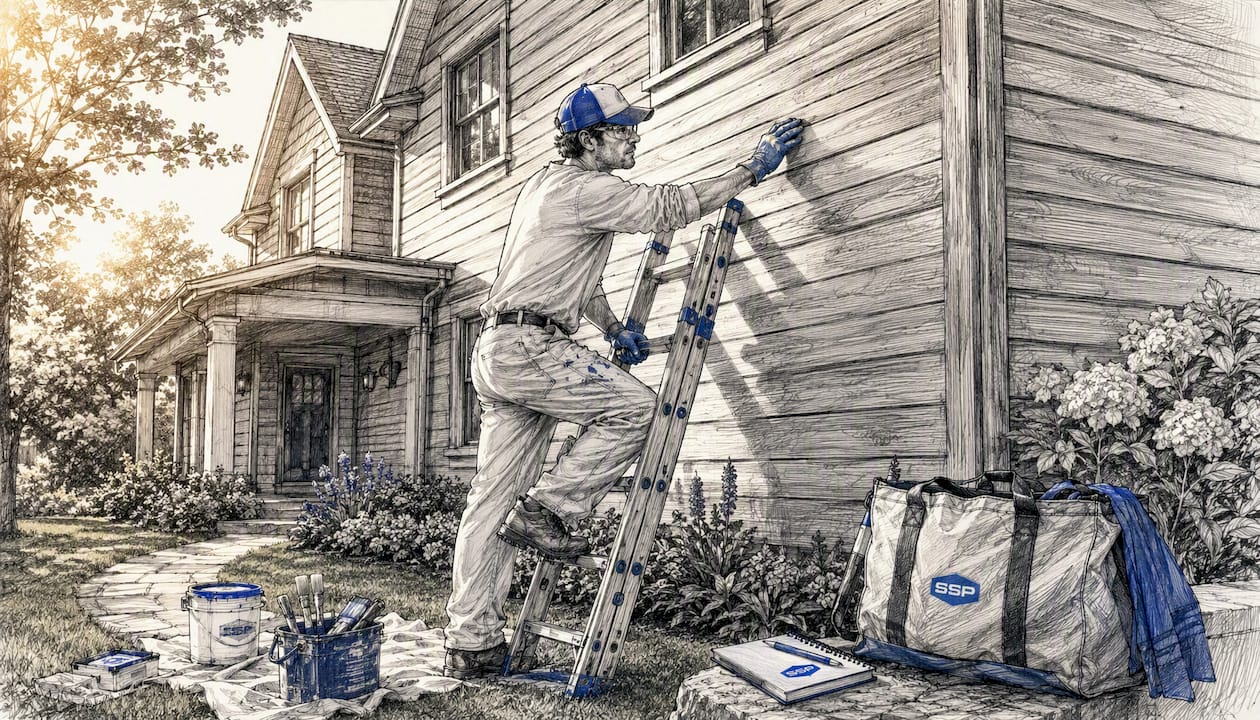
Siding material is one of the most significant price drivers on exterior work. Smooth vinyl siding is the fastest to prep and paint. Wood siding, especially older lap siding with peeling paint, requires far more prep time: scraping, sanding, spot priming, and often caulking at every joint. Stucco and masonry surfaces absorb more paint per coat and may need a specialized primer, which raises both material and labor costs. Rooflines with dormers, gable ends, and complex trim details add hours that flat-walled homes simply don't carry.
Access costs are a separate line item many homeowners don't anticipate. A standard two-story home can usually be reached with extension ladders, but homes with steep pitches, three-story sections, or limited yard clearance may require a boom lift or scaffolding rental, which can add $500–$1,500 to the project total.
Common exterior add-ons that appear in professional estimates:
- Power washing and mildew treatment before painting
- Fascia, soffit, and trim repairs or replacement
- Caulking at windows, doors, and siding joints
- Lead-safe containment and disposal for pre-1978 homes
- Garage doors, shutters, and fencing (usually quoted separately)
Weather and scheduling also affect exterior projects in ways that interior work avoids. Paint manufacturers specify minimum application temperatures and humidity limits, and a contractor who ignores those specs to meet a deadline creates adhesion failures that show up within a year.
How does a professional painting estimate break down?
A well-structured painting estimate separates costs into distinct categories, and understanding each one lets you compare bids accurately rather than just comparing totals. TheFatBook's 2026 breakdown shows labor representing approximately 44% of total cost on a baseline 2,500 sq ft home, with the full interior at $5,041 and exterior at $4,672 for that same property.
For the U.S. average, TheFatBook reports a whole-house interior-plus-exterior painting cost of $9,899 for a 2,500 sq ft home in 2026, with most bids falling between $9,060 and $11,984 depending on region and scope. Prep includes cleaning, patching, sanding, caulking, and priming, and it can account for 30–50% of total labor hours on a job with any surface issues. A quote that skips detailed prep line items is almost always a low bid that will fail early, not a contractor who found a more efficient method.
Equipment, disposal, and overhead round out the estimate. Disposal of paint waste, drop cloths, and masking materials has a real cost. Contractor overhead (insurance, licensing, vehicles, estimating time) and margin are legitimate components of any professional bid.
Pro Tip: If an estimate uses the phrase "prep as needed" without specifying what that prep includes, ask the contractor to itemize it. That phrase is frequently used to justify cutting prep on the job without technically misrepresenting the bid. A professional estimator should be able to tell you exactly how many hours of prep are budgeted and what tasks are included.
Sample project estimates: what real jobs actually cost
The table below uses three columns: Low assumes value-grade paint, minimal prep (new or recently painted surfaces in good condition), and one coat over a similar color. Mid assumes premium paint, standard prep (patching, caulking, one coat of primer where needed), and two coats. High assumes top-tier paint, significant prep (heavy patching, full prime coat, color change), and two finish coats.
| Project | Low | Mid | High | Key Assumptions |
|---|---|---|---|---|
| 12×12 bedroom, walls only | — | $450 | — | Low: 1 coat, minimal prep; High: color change, patching |
| 12×12 bedroom, walls + trim + ceiling | $500 | — | — | Low: same color; High: full prime + 2 coats |
| Living room (—) | — | — | — | High includes ceiling and accent wall |
| Kitchen (10×12 ft) | $400 | $700 | — | High includes cabinet-adjacent trim and grease prep |
| Trim-only job (whole house) | — | — | — | Varies heavily by linear footage and detail |
| Full interior, 1,500 sq ft | — | — | — | Low: value paint, good condition; High: full prep |
| Full interior, 2,000 sq ft | $5,041 | — | — | Standard prep cited from TheFatBook |
| Full interior, 2,500 sq ft | $5,041 | — | — | TheFatBook baseline, standard prep, two coats |
How do painters quote jobs, and which pricing model is fairest?
Painters use four common pricing structures, and knowing how to convert between them helps you compare bids that arrive in different formats.
Per-square-foot pricing works well for large, open spaces where the estimator can measure quickly and apply a consistent rate. It's the most transparent model for whole-house projects because it ties directly to the scope. At $3/sq ft for a 2,000 sq ft interior, the math is straightforward: $6,000 before any add-ons. The risk is that a low per-sq-ft rate may hide inadequate prep hours.
Per-room flat pricing is common for smaller scopes and easier for homeowners to budget. A contractor quoting $450 per standard bedroom and $700 per living room is essentially doing the same math internally, just presenting it differently. Ask what's included per room (coats, trim, ceiling) so you're comparing equivalent scopes.
Hourly or day rates appear most often for touch-up work, small repairs, or jobs where the scope is genuinely uncertain. Typical painter day rates vary depending on region and skill level. For a defined project, hourly billing introduces uncertainty; a flat bid is almost always preferable.
Flat project bids are the standard for full interior or exterior repaints. The contractor absorbs the risk of underestimating hours, which incentivizes accurate prep assessment upfront. A flat bid should still be accompanied by a written scope of work so you know exactly what's covered if a dispute arises.
To convert a per-sq-ft bid to a room price: multiply the room's wall area (perimeter × ceiling height, minus doors and windows) by the rate. A 12×12 room with 9-ft ceilings has roughly 400 sq ft of wall area. At $3/sq ft, that's $1,200 before trim and ceiling, which is why per-room flat rates often come in lower than per-sq-ft math suggests for smaller spaces.
What should a written estimate include, and how do you vet the contractor?
A written estimate is your primary protection against scope disputes and surprise charges. Consumer Reports recommends that professional estimates be broken down line by line and that contractors provide three verifiable local references from jobs completed within the last 12 months.
Written estimate checklist:
- Scope of work: exact rooms or surfaces covered, what is explicitly excluded
- Surface prep line items: patching, sanding, caulking, priming (hours or tasks, not "as needed")
- Number of coats for each surface type
- Paint brand, product line, and SKU (not just "premium paint")
- Labor hours or crew size and estimated start and completion dates
- Payment terms and schedule (avoid contractors requiring full payment upfront)
- Warranty terms: what's covered, for how long, and what voids it
- Cleanup and disposal plan
- Permit or RRP certification notes if applicable
Vetting questions to ask the estimator:
- Are you licensed in California, and can you provide your contractor license number?
- Do you carry general liability and workers' compensation insurance? (Request certificates.)
- Who will be on-site supervising the crew daily?
- Can you provide three local references from jobs completed in the last year?
- How do you handle warranty claims if the finish fails within the first year?
A skilled estimator with at least five years' experience should answer licensing, insurance, and crew structure questions quickly and confidently. Evasiveness on any of those points is a meaningful red flag, not a minor concern.
Red flags to watch for:
- Vague prep language ("prep as needed," "clean and paint")
- Cash-only payment requests or pressure to decide same-day
- No local references from the past 12 months
- No proof of general liability or workers' comp insurance
- No mention of RRP certification when the home was built before 1978
For California-specific licensing requirements, Southshorepaint's guide on hiring a licensed painting contractor covers what to verify and where to check. Understanding what insurance a painting company should carry is equally important before signing any contract.
Practical ways to lower your painting bill without shortening the finish life
The most effective cost reductions come from reducing crew time on tasks homeowners can handle themselves, not from cutting prep or switching to cheaper paint.
Do your own furniture moving and surface clearing. Moving furniture out of rooms, removing curtains and hardware, and clearing shelves takes meaningful crew time. Doing this yourself before the painters arrive can reduce billable hours on a full interior project. It's low-skill work that doesn't affect finish quality.
Time the project strategically. Shoulder seasons (late winter through early spring for interiors, early fall for exteriors) tend to carry shorter lead times and occasionally better pricing as contractor schedules open up. Mid-week start dates also reduce scheduling friction for most crews. Combining multiple rooms or interior and exterior work into a single contract often yields a better per-room rate than booking them separately.
Understand the paint quality tradeoff honestly. Premium paint costs $20–$40 more per gallon than value-grade products, but it typically covers in fewer coats and holds color longer. On a 2,000 sq ft interior requiring 10 gallons of finish paint, the upgrade costs $200–$400 more in materials. If it eliminates one coat pass, the labor savings can offset that difference entirely. Where premium paint rarely makes sense is on surfaces that will be repainted in two to three years anyway, like a rental property or a home being prepared for sale.
Trim scope thoughtfully. Deferring the garage interior, garden shed, or a secondary bathroom to a future project is a legitimate way to reduce the current contract without compromising the primary work. Accent walls, decorative finishes, and specialty coatings are also easy to defer. What you should not cut is prep: a contractor who agrees to skip caulking or priming to lower the price is setting you up for a finish that fails in 18 months.
How long does a professional painting project take?
Timeline expectations vary considerably by scope, and a contractor who promises an unrealistically fast turnaround on a complex job is worth questioning.
A single standard bedroom takes one to two days for a professional crew: one day for prep and first coat, a second day for the finish coat after adequate drying time. A full interior repaint of a 2,000 sq ft home with standard prep typically runs five to eight working days. Homes with significant surface repairs, multiple color changes, or detailed trim work can extend that to two weeks.
Exterior projects depend heavily on weather. A straightforward single-story repaint might take three to five days of actual work, but weather holds, required drying windows between coats, and scheduling gaps can stretch the calendar timeline to two to three weeks. Two-story homes with complex rooflines or scaffolding requirements add setup and teardown days on both ends.
Drying and recoat windows matter more than most homeowners realize. Most latex paints require four to six hours between coats under ideal conditions (65–85°F, moderate humidity), but oil-based primers and specialty coatings can require 24 hours or more. Masonry surfaces, including stucco, need to cure fully before painting, and new stucco may require 28–60 days of cure time before a finish coat is appropriate.
The final walkthrough and punchlist are standard parts of a professional job. Plan for a walkthrough with the contractor before final payment, and expect minor touch-ups to be addressed within a few days. A contractor who resists a formal walkthrough or rushes past it is worth noting.
For scheduling guidance specific to the South Bay, Southshorepaint's homeowner scheduling guide covers lead times and what to expect in 2026.
Key Takeaways
Professional painting cost in the U.S. ranges broadly from several thousand dollars for a single-room interior scope to significantly more for a full interior-plus-exterior repaint, with labor and prep consistently representing the largest share of any bid.
| Point | Details |
|---|---|
| Budget by scope | Interior-only and exterior-only projects vary considerably in cost; full repaint projects for a typical 2,500 sq ft home fall within a mid to high price range nationally. |
| Prep drives longevity | Surface prep accounts for 30–50% of labor hours; a bid that skips detailed prep is a bid that will fail early. |
| Demand line-item estimates | Ask for paint brand and SKU, prep tasks itemized, coat count, and warranty terms in writing before signing. |
| Verify credentials | Confirm licensing, general liability, and workers' comp insurance; request three local references from the past 12 months. |
| Southshorepaint in South Bay | Southshorepaint provides written, line-item estimates with specified materials, RRP compliance when required, and local South Bay references. |
Why the cheapest bid is almost never the best value
The pattern repeats often enough to be worth stating plainly: the lowest bid on a painting project is usually low because it skips prep, uses fewer coats, or employs uninsured labor. None of those savings belong to the homeowner. They show up later as peeling paint, callbacks that go unanswered, and a repaint cycle that starts two years earlier than it should.
What actually determines whether a paint job holds up is the condition of the surface before the first coat goes on. Caulking, patching, sanding, and priming are not optional steps that skilled painters skip for efficiency. They are the job. A contractor who bids $1,500 less than everyone else and can't explain where that savings comes from in the prep scope is not offering a better deal. They're offering a shorter finish life.
That said, not every premium charge is justified either. Homeowners who do their own furniture moving, choose a standard color palette rather than a complex multi-color scheme, and schedule during a contractor's slower season can legitimately reduce costs without affecting quality. The distinction worth holding onto is this: reduce scope where it doesn't affect longevity, and protect prep and materials where it does.
The cost factors that drive painting prices are knowable and comparable across bids. A homeowner who asks the right questions before signing gets a better result than one who selects on price alone.
What to expect from a Southshorepaint estimate
Southshorepaint serves homeowners, landlords, and property managers throughout the South Bay with interior and exterior painting, cabinet refinishing, drywall repair, and surface preparation using premium, long-lasting materials. Every estimate is written and line-itemed: prep tasks are specified, paint brand and product line are named, coat count is stated, and warranty terms are included before any contract is signed. For homes built before 1978, RRP lead-safe protocols are identified and addressed in the estimate rather than discovered mid-project.

Local references from recent South Bay projects are available on request, and the estimating process is designed to give homeowners a clear, comparable document rather than a single-number quote that obscures what's actually being done. If you're evaluating bids or planning a repaint, request a written estimate from Southshorepaint and see exactly what a line-item proposal looks like in practice.
Useful sources and verification links
The cost figures in this guide draw from the following sources, which homeowners can use to cross-check ranges and run their own estimates:
- TheFatBook 2026 Cost Index — national whole-house averages, metro-level variation, and component cost breakdowns
- TheFatBook: Whole House Painting Cost — labor share analysis and minimum charge data
- TheFatBook: Interior Painting Cost Breakdown — prep labor share and RRP cost impact
- FacadeColorizer Interior Painting Cost Guide 2026 — per-sq-ft and per-room benchmarks with a free calculator
- PaintPricing: Cost to Paint a House — per-sq-ft ranges and major price-driver explanations
- PaintPricing: Questions to Ask a Painter — vetting checklist and red-flag guidance
- NerdWallet: Cost to Paint a House 2026 — national averages and savings tips
- Consumer Reports: How to Hire a Painter — written estimate and reference standards
For EPA RRP requirements on pre-1978 homes, the EPA's Renovation, Repair, and Painting rule is the primary source. Any contractor working on a pre-1978 home in California should be able to provide their RRP certification number on request.