

Insurance is the primary financial defense for any painting company, protecting against property damage claims, bodily injury lawsuits, and liability losses that can arise on any job site. Business owners and property managers who hire painting contractors carry real exposure when those contractors lack proper coverage. The role of insurance in painting companies extends beyond paperwork. It determines whether a contractor can legally operate, win commercial bids, and absorb mistakes without shutting down. Understanding paint company liability coverage gives you the tools to evaluate contractors with confidence and protect your own assets in the process.
What types of insurance coverage are essential for painting companies?
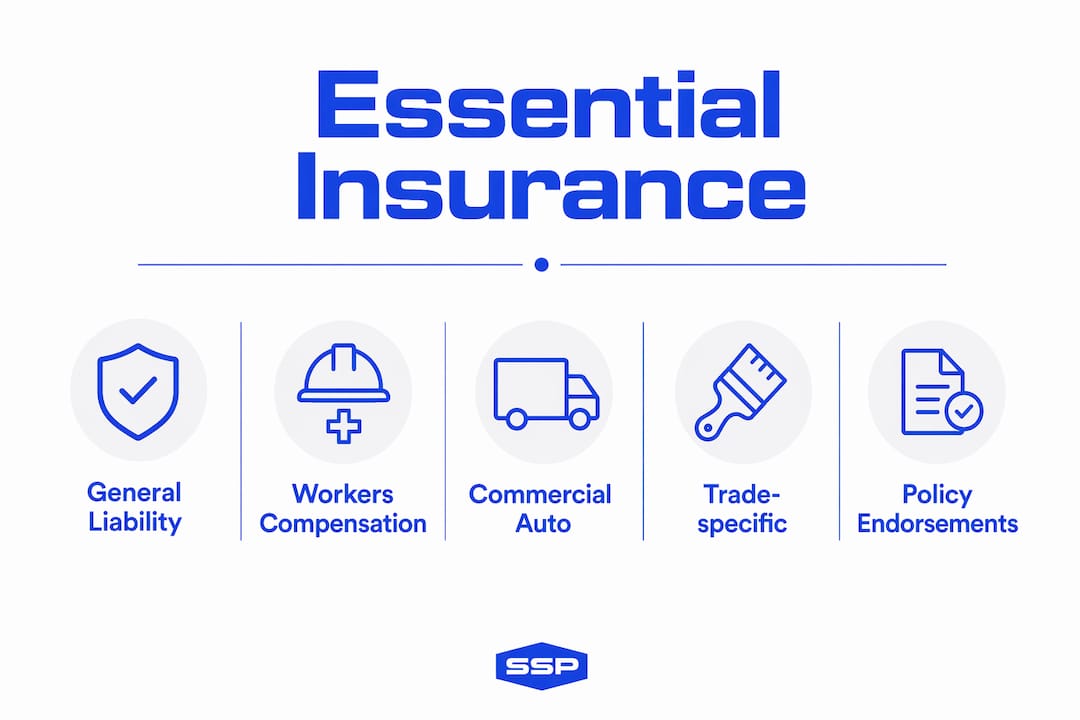
General liability insurance is the foundation of any painting contractor's coverage. It covers third-party bodily injury and property damage during active painting work, including incidents like paint spills on flooring, a ladder falling onto a client's vehicle, or a worker accidentally breaking a window. Without it, a single claim can exceed what most small painting businesses hold in operating capital.

Workers' compensation is the second non-negotiable policy. Workers' comp is required once a painting company has employees, covering medical bills and lost wages when a worker is injured on the job. Falls from ladders and scaffolding are among the most common causes of serious injury in the painting trade, making this coverage especially relevant.
Commercial auto insurance covers vehicles used to transport crews, equipment, and materials. Personal auto policies typically exclude business use, meaning an accident in a company truck without commercial coverage leaves the contractor and property owner exposed.
Beyond those three core policies, painting companies should carry:
- Tools and equipment coverage: Protects sprayers, compressors, and other gear against theft or damage in transit or on-site.
- Contractor pollution liability: Covers claims from chemical exposure, lead paint disturbance, or solvent fumes affecting neighboring properties or occupants.
- Umbrella liability: Extends limits above the base general liability policy, often required on larger commercial projects.
- Completed operations coverage: Protects against claims that arise after a job is finished, such as paint peeling that damages a surface or causes a slip.
Pro Tip: Trade-specific insurance policies outperform generic contractor policies by better matching the actual risk profile of painting work. Ask any contractor you hire whether their policy is classified under a painting trade code, not a general contractor code.
How much does insurance cost for painting contractors?
The average monthly cost for painting contractor business insurance is $183, or approximately $2,191 annually. That figure represents a standard general liability policy for a small painting operation. It does not account for workers' compensation, commercial auto, or specialty endorsements, which add to the total.
Regional pricing varies significantly. There is a 191% cost spread between the lowest and highest cost states, with West Virginia averaging $125 per month and California averaging $365 per month. That gap reflects differences in litigation rates, labor costs, and state regulatory environments. If you manage properties in California, expect contractors to carry higher premiums, which often shows up in their bid pricing.
Several factors push premiums higher:
| Factor | Effect on Premium |
|---|---|
| More employees | Higher workers' comp and liability costs |
| Commercial vs. residential work | Commercial jobs typically cost more to insure |
| Higher coverage limits | Directly increases base premium |
| Specialty work (lead, heights) | Requires endorsements that add cost |
| Claims history | Prior claims raise rates significantly |
| State of operation | Wide regional variation in base rates |
Accurate trade classification also affects cost. Using generic contractor codes instead of painting-specific codes risks both overpayment and coverage gaps. A policy misclassified under a general contractor code may deny a claim that falls squarely within painting operations.
Pro Tip: When reviewing a contractor's certificate of insurance, check the classification description. It should reference painting or surface coating work specifically, not just "general contractor" or "construction."
What insurance requirements do commercial painting contracts mandate?
Commercial painting contracts set clear minimum standards. The industry benchmark is $1 million per occurrence and $2 million aggregate for general liability. These limits mean the insurer pays up to $1 million for any single claim and up to $2 million total across all claims in a policy year. Most property management companies and general contractors will not award a bid without proof of these minimums.
A Certificate of Insurance (COI) is the document that confirms coverage. Property managers typically require a COI before work begins, and the COI must name the property owner or management company as an additional insured. Standard COIs can be issued the same day for general liability policies. Workers' compensation and commercial auto certificates may take 24–48 hours. A contractor who cannot produce a COI quickly is a red flag in a competitive bidding environment.
Beyond the basic COI, commercial contracts often require specific endorsement language:
- Additional insured status: The property owner is covered under the contractor's policy for claims arising from the contractor's work.
- Primary and noncontributory language: The contractor's policy pays first, before any coverage the property owner carries.
- Waiver of subrogation: The insurer cannot sue the property owner to recover money it paid out on a claim.
- CG 20 10 and CG 20 37 endorsements: These cover ongoing operations and completed operations respectively. Without these endorsements, claims may be denied even when a valid policy exists.
Missing any of these requirements can disqualify a contractor from a bid entirely. Property managers who skip this verification step take on liability that should belong to the contractor. You can review what licensed painting contractors in California are required to carry as a practical benchmark for other states.
What are the benefits of carrying proper insurance for painting companies?
Proper insurance protects business cash flow. A single overspray or paint damage claim on a neighboring property can generate costs that exceed a small contractor's annual profit. Insurance absorbs that hit without forcing the contractor to shut down or walk away from the job.
For property managers, the benefits are equally direct. Hiring an insured contractor transfers financial risk away from your portfolio. If a painter damages a tenant's belongings or a visitor is injured on a job site, the contractor's liability policy responds first. That protection is especially relevant for landlords managing multiple properties, where a single uninsured incident can create cascading liability.
Insurance also functions as a professional credential. Property managers and general contractors filter contractors by COI availability, treating insurance as a baseline qualifier rather than a bonus. An uninsured painter is effectively invisible to any serious commercial client. Carrying proper coverage signals that a company operates with discipline and accountability.
The practical advantages for painting companies include:
- Bid eligibility: Most commercial and government contracts require proof of insurance before a contractor can submit a proposal.
- Client confidence: Clients are more likely to approve a project and pay promptly when they know the contractor is covered.
- Legal compliance: Many states require workers' compensation and general liability as a condition of holding a contractor's license.
- Project continuity: When a covered incident occurs, the insurer manages the claim. The painting company keeps working.
Trade-specific coverage also outperforms generic policies in claim outcomes. A policy written for painting operations includes the specific risk categories that arise in this trade, reducing the chance of a denied claim due to a coverage mismatch.
Key takeaways
Proper insurance is the single most important qualification a painting contractor can demonstrate to a property manager or business owner.
| Point | Details |
|---|---|
| Core coverage requirement | General liability, workers' comp, and commercial auto are the minimum three policies every painting company needs. |
| Cost benchmark | Painting contractor insurance averages $183 per month, with significant variation by state and job type. |
| Contract minimums | Most commercial contracts require $1M per occurrence and $2M aggregate liability limits with specific endorsements. |
| COI verification | Always request a COI with additional insured status, primary and noncontributory language, and waiver of subrogation. |
| Trade classification matters | Policies classified under painting trade codes provide better coverage and more accurate pricing than generic contractor codes. |
Why I think most property managers underestimate this issue
Most property managers I speak with treat insurance verification as a checkbox. They ask for a COI, glance at the limits, and move on. That approach misses the details that actually determine whether a claim gets paid.
The endorsements are where coverage lives or dies. A contractor can hand you a certificate showing $2 million in aggregate coverage, but if the policy lacks CG 20 10 and CG 20 37 endorsements, completed operations claims may be denied outright. That means if paint damage shows up three months after the job ends, you may have no recourse against the contractor's insurer.
The classification code issue is equally underappreciated. Many painting contractors carry policies written under generic construction codes because they are cheaper. Those policies often exclude the specific risks of painting work, including height exposures and chemical contamination. The contractor saves $40 a month on premiums, and you absorb the gap when something goes wrong.
My recommendation is to treat insurance review the same way you treat a contract review. Read the endorsements. Confirm the trade classification. Verify that the COI names your entity correctly and includes the required language. A contractor who pushes back on any of those requests is telling you something important about how they run their business.
— Ryan
Southshorepaint: insured, documented, and ready to work
Southshorepaint carries industry-standard general liability coverage, workers' compensation, and commercial auto insurance on every project. We provide a Certificate of Insurance promptly, with the endorsements and additional insured language that property managers and commercial clients require.

Our policies meet or exceed the $1 million per occurrence and $2 million aggregate minimums standard in commercial painting contracts. We understand that for property managers and business owners, a contractor's insurance is not a formality. It is a condition of doing business. If you are evaluating painting services for your property or portfolio, review our painting services and request a COI as part of your first conversation. We will have it ready.
FAQ
What is the role of insurance in painting companies?
Insurance protects painting companies and their clients from financial losses caused by property damage, bodily injury, and liability claims during or after a project. It also serves as a professional credential required by most commercial contracts.
What insurance does a painting contractor need?
A painting contractor needs general liability, workers' compensation, and commercial auto insurance at minimum. Specialty coverages like contractor pollution liability and completed operations endorsements are required for many commercial jobs.
How much does painting contractor insurance cost?
Painting contractor insurance averages $183 per month or $2,191 annually for a standard general liability policy, with costs varying significantly by state, number of employees, and coverage limits.
What should a COI include for a painting contractor?
A COI should list the property owner as an additional insured, include primary and noncontributory language, carry a waiver of subrogation, and reference CG 20 10 and CG 20 37 endorsements for full commercial compliance.
Why do commercial contracts require specific insurance limits?
Commercial contracts set minimum limits of $1 million per occurrence and $2 million aggregate to protect property owners from claims that exceed a contractor's ability to pay out of pocket. Umbrella policies are often required on larger projects to extend those limits further.