

Sustainable painting is the practice of using low-impact, eco-friendly paints and application methods to reduce environmental harm while delivering durable, healthy finishes. What makes painting sustainable comes down to three factors: what goes into the paint, how it performs over time, and how little it harms the air inside your home. Unlike conventional coatings, sustainable paints rely on bio-based ingredients, low or zero VOC formulations, and third-party certifications like USDA BioPreferred and Eurofins Indoor Air Comfort Gold to prove their claims. For homeowners weighing a repaint project, understanding these distinctions means the difference between a finish that looks good and one that is genuinely good for your household.
What is sustainable painting, and how is it defined?
Sustainable painting is defined as the use of paints, coatings, and application techniques that minimize environmental impact across the full product lifecycle. That lifecycle includes raw material sourcing, manufacturing, application, indoor air quality, and eventual disposal. No single global legal definition exists for sustainable paint. Sustainability is instead evaluated through renewable sourcing, emissions testing, and lifecycle durability. That absence of a legal standard is exactly why certifications matter so much.
The term "eco-friendly paint" is widely used in marketing, but it carries no automatic regulatory weight. A product labeled "natural" may still contain synthetic preservatives or petroleum-derived binders. Homeowners benefit from looking past the label and checking for verifiable third-party credentials. Certifications like Cradle to Cradle and Eurofins Indoor Air Comfort Gold require independent testing, not just manufacturer claims.
Durability is also a core part of the definition. A paint that chips, fades, or requires recoating every two years consumes more resources over time than a longer-lasting conventional coat. Sustainability in paint is multi-dimensional, covering renewable sources, emissions, and durability to reduce waste and exposure comprehensively. A truly sustainable finish is one you do not need to redo for years.
What ingredients and certifications make painting truly sustainable?
The ingredients inside a paint can determine its environmental and health profile more than any marketing claim. Sustainable paints commonly use clay, lime, plant oils, and bio-based acrylic binders as their primary film-forming components. These materials are either naturally occurring or derived from renewable agricultural sources, which reduces dependence on petroleum-based chemistry.
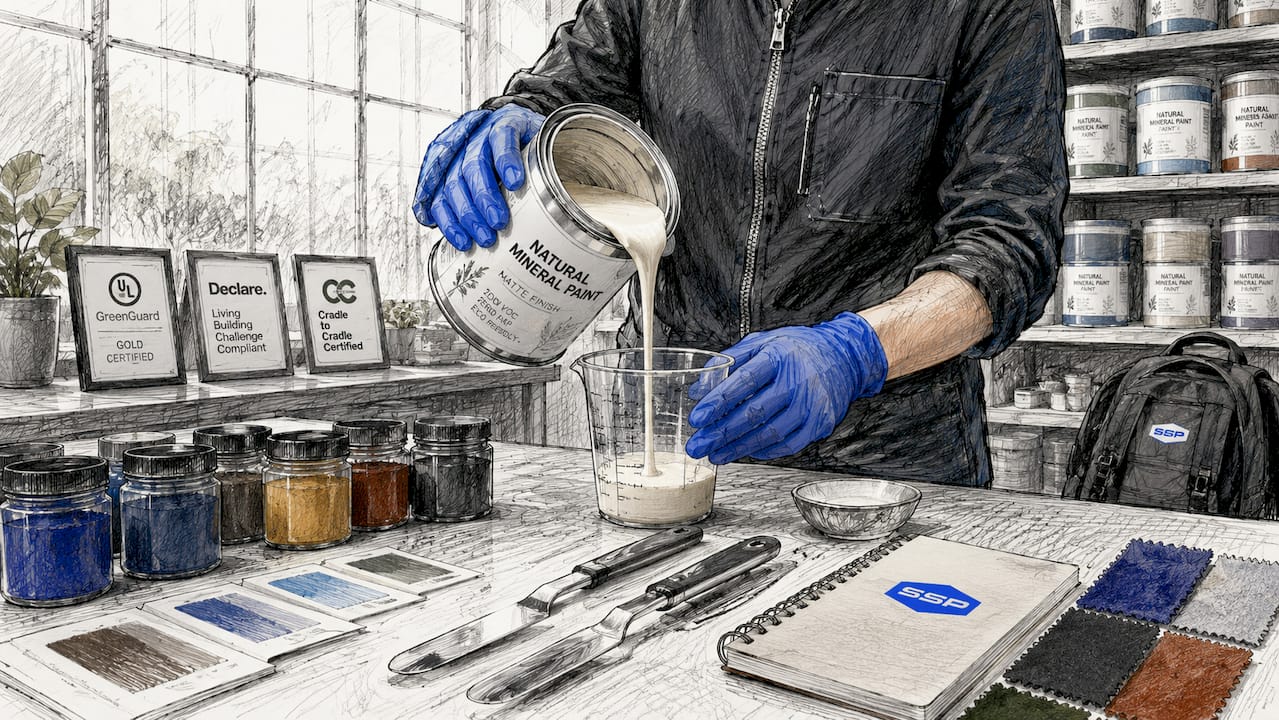
VOC content is the most widely cited measure of a paint's indoor air safety. Industry standards define low-VOC paints as containing under 50 g/L and zero-VOC paints as under 5 g/L. That threshold matters because VOCs off-gas into your living space after application, contributing to headaches, respiratory irritation, and long-term indoor air quality problems.
Key certifications homeowners should look for include:
- Eurofins Indoor Air Comfort Gold: Tests for VOC emissions in real indoor conditions, not just at the factory.
- USDA BioPreferred: Confirms a minimum percentage of bio-based carbon content in the product.
- Cradle to Cradle: Evaluates material health, recyclability, and manufacturing practices across the product's full lifecycle.
- Greenguard Gold: Sets strict chemical emission limits, with a specific focus on products used in schools and healthcare environments.
Breathability is another technical property that separates sustainable paints from conventional ones. Mineral and clay-based paints allow moisture vapor to pass through walls, expressed as a low Sd value. This reduces condensation buildup inside wall cavities, which in turn lowers the risk of mold growth. Conventional vinyl-based paints can trap moisture, creating conditions that damage both the wall and indoor air quality over time.
Pro Tip: Ask your paint supplier for the product's Sd value. A lower Sd value means better breathability, which is especially important in bathrooms, kitchens, and older homes with limited vapor barriers.
One persistent myth is that natural or eco-friendly paints cannot hold up to daily wear. Modern sustainable paints can achieve Class 1 wet scrub ratings, the highest durability classification for washability. That performance level matches or exceeds many conventional interior paints.
How do sustainable paints compare to conventional paints?
The performance gap between eco-friendly and conventional paints has narrowed considerably. The comparison below covers the most practical factors for homeowners.
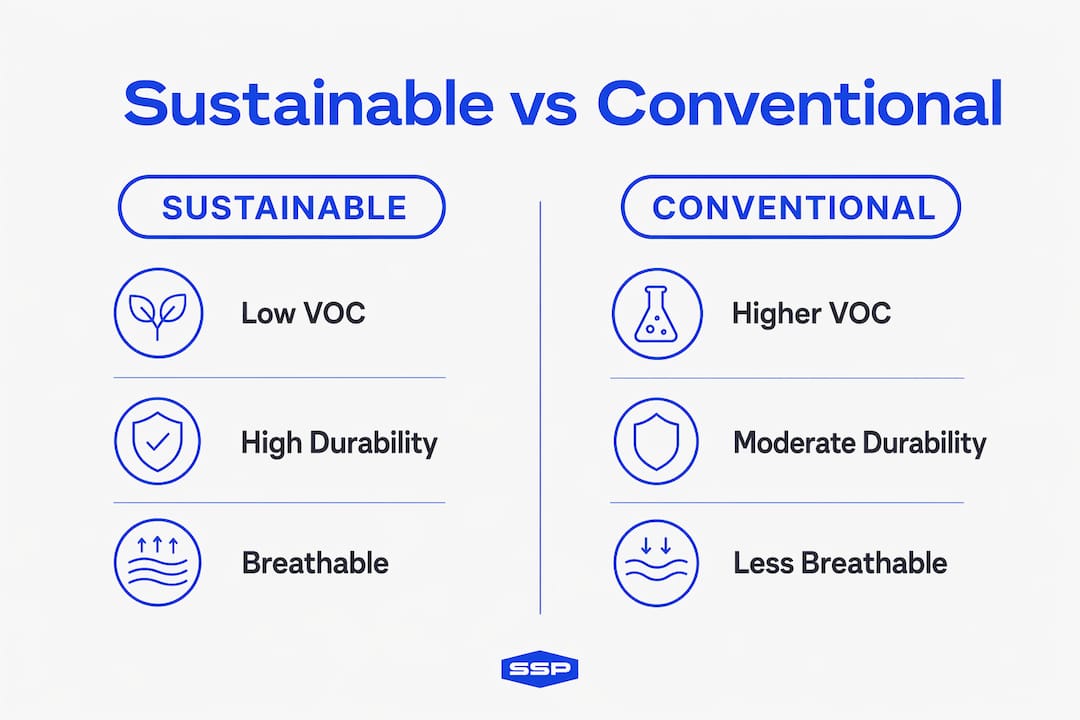
| Factor | Sustainable paints | Conventional paints |
|---|---|---|
| VOC content | Under 5–50 g/L depending on grade | Often 150–400 g/L or higher |
| Durability | Class 1 wet scrub achievable | Class 1 standard in premium lines |
| Bio-based content | Up to 27% bio-based carbon in acrylic binders | Primarily petroleum-derived |
| Shelf life | Shorter for natural clay and lime paints | Longer with synthetic preservatives |
| Carbon footprint | Significantly reduced in modern formulations | Higher across production and use |
The carbon footprint data is striking. Coatings production reduced its carbon footprint two-fold and consumption footprint five-fold between 2020 and 2026. That improvement reflects both cleaner manufacturing and longer-lasting formulations that require fewer recoats over a building's life.
There are real trade-offs to acknowledge. Natural paints like clay or limewash have shorter shelf lives and are often sold bundled with application services. A clay paint mixed without synthetic preservatives may need to be used within days of opening. That is not a dealbreaker, but it does require planning your project timeline carefully.
Color range is another area where eco-paints have improved dramatically. Consumer awareness and technology have matured so that modern sustainable paints deliver vibrant colors, durability, and improved health outcomes compared to past formulations. The muted, chalky palette that once defined natural paints is largely a thing of the past.
Pro Tip: When comparing paint products, check the VOC content after tinting, not just the base paint. Tinting zero-VOC base paints can introduce small amounts of VOC unless factory-tinted with dedicated zero-VOC colorant systems.
What application practices optimize sustainable painting benefits?
Choosing the right paint is only half the equation. How and when you apply it determines whether the health and environmental benefits actually reach your home. Eco-friendly painting practices treat the application process as seriously as the product itself.
Ventilation after painting is the most critical and most overlooked step. Sustainable painting requires 48–72 hours of ventilation after application as a standard practice. For nurseries, bedrooms used by people with respiratory conditions, or any sensitive environment, allow 7 full days before regular occupancy. Most homeowners open a window for a few hours and consider the job done. That is not enough.
Air purifiers are not a reliable substitute for ventilation. Proper airflow and sustained ventilation are critical to clearing VOCs because most air purifiers do not capture them effectively. Opening windows on opposite sides of a room to create cross-ventilation is more effective than any filter-based device.
The following steps reflect best practices for getting the most out of environmentally friendly painting:
- Choose factory-tinted zero-VOC paint. Request tinting at the store using a dedicated zero-VOC colorant system. This prevents VOC contamination that can occur when standard tints are added to a zero-VOC base.
- Use HVLP application equipment. High-efficiency tools like HVLP sprayers reduce paint waste and overspray, which lowers both material consumption and airborne particulate during application.
- Schedule painting during mild weather. Temperatures between 50°F and 85°F with moderate humidity allow paint to cure properly. Extreme heat accelerates off-gassing, while cold slows curing and can compromise adhesion.
- Ventilate continuously for the full cure period. Keep windows open and use fans to maintain airflow for at least 48 hours, or 7 days in sensitive spaces.
- Prep surfaces without solvent-based strippers. Use water-based or mechanical prep methods to avoid introducing additional VOCs before the paint even goes on.
Scheduling matters as much as technique. Painting in spring or early fall, when windows can stay open without extreme temperature swings, gives the paint the best conditions to cure and off-gas safely. A wall painting guide that accounts for surface prep, timing, and ventilation will consistently outperform one focused only on product selection.
Which sustainable painting products and trends are shaping home improvement in 2026?
The sustainable coatings market in 2026 is not a niche category. It is the direction the entire industry is moving, driven by tighter regulations, consumer demand, and genuine improvements in bio-based chemistry.
Bio-based acrylic latex binders now contain approximately 27% bio-based carbon, qualifying them for USDA BioPreferred certification. These binders perform comparably to petroleum-derived acrylics in adhesion, flexibility, and washability. The shift matters because acrylic latex is the most common binder in interior and exterior residential paints.
Several trends are defining the current market:
- Limewash revival: Traditional limewash paint has been reformulated with modern mineral binders for improved durability and a wider color range. It remains highly breathable and naturally antimicrobial, making it a strong choice for older homes and high-humidity rooms.
- Circular economy packaging: Several manufacturers now offer paints in recyclable or refillable containers, reducing plastic waste at the consumer level.
- Zero-VOC factory tinting systems: More retailers are investing in dedicated zero-VOC colorant systems so that the final tinted product maintains its certification status.
- Green building integration: Sustainable paints are increasingly specified in LEED and WELL building projects, which means the product standards are being validated at the commercial and institutional level before reaching the residential market.
For homeowners exploring modern home painting ideas, the good news is that sustainable options now cover every finish type, from flat ceilings to high-gloss trim. The performance and aesthetic limitations that once pushed buyers toward conventional paints have largely been resolved.
Key takeaways
Sustainable painting delivers measurable environmental and health benefits when the right products, certifications, and application techniques are combined.
| Point | Details |
|---|---|
| VOC thresholds define categories | Low-VOC paints contain under 50 g/L; zero-VOC paints contain under 5 g/L. |
| Certifications verify claims | Look for Eurofins Indoor Air Comfort Gold, USDA BioPreferred, or Cradle to Cradle on any product you consider. |
| Durability is no longer a trade-off | Modern eco-paints achieve Class 1 wet scrub ratings, matching premium conventional products. |
| Ventilation is non-negotiable | Allow 48–72 hours of airflow after painting; extend to 7 days for nurseries or sensitive occupants. |
| Tinting can add VOCs | Request factory-tinted zero-VOC paint to avoid VOC contamination from standard colorant systems. |
What I've learned from watching the eco-paint market mature
The biggest misconception I still hear from homeowners is that choosing sustainable paint means accepting a compromise. Softer colors, shorter coverage, or a finish that scuffs after one season. That was a fair concern ten years ago. It is not a fair concern now.
What I have seen change is not just the chemistry. It is the whole-system thinking behind green painting. The product is only as good as the prep, the application method, and the ventilation that follows. A zero-VOC paint applied with a cheap roller in a sealed room with no airflow is not a sustainable outcome. The paint did its part. The process did not.
The other thing worth saying plainly: the certification labels are doing real work. Eurofins Indoor Air Comfort Gold and USDA BioPreferred are not marketing badges. They require independent testing. When I see those marks on a product, I trust the VOC claims. When I see "natural" or "eco" without any third-party verification, I read the ingredient list carefully.
Sustainable painting fits naturally into any broader green home improvement plan. It pairs well with low-VOC caulks, water-based primers, and mechanical surface prep. None of those choices require a major budget increase. They require attention and the right contractor.
— Ryan
Southshorepaint and eco-friendly home painting
Southshorepaint works with homeowners who want results that last and materials they can feel good about. The focus has always been on proper prep, premium products, and workmanship built to hold up over time. That approach aligns directly with sustainable painting principles: fewer recoats, less waste, and a healthier finished environment.

Whether you are planning an interior refresh with zero-VOC paints or an exterior project using durable, low-emission coatings, Southshorepaint can guide you through product selection and application. The team understands the certifications, the ventilation requirements, and the techniques that make eco-friendly results stick. Visit Southshorepaint to learn more about sustainable residential painting services and get a project consultation.
FAQ
What is the difference between low-VOC and zero-VOC paint?
Low-VOC paints contain under 50 g/L of volatile organic compounds, while zero-VOC paints contain under 5 g/L. Zero-VOC products produce significantly less off-gassing and are the better choice for bedrooms, nurseries, and spaces with limited ventilation.
Are sustainable paints as durable as conventional paints?
Modern eco-friendly paints can achieve Class 1 wet scrub ratings, the highest washability classification available. Durability is no longer a meaningful trade-off when choosing certified sustainable products.
How long should I ventilate after painting with eco-friendly paint?
The standard recommendation is 48–72 hours of continuous airflow after application. For nurseries or spaces occupied by people with respiratory sensitivities, allow a full 7 days before regular use.
Can I tint zero-VOC paint without adding VOCs?
Standard tinting at a paint counter can introduce small amounts of VOC into a zero-VOC base. Requesting factory-tinted paint using a dedicated zero-VOC colorant system prevents this and preserves the product's certification status.
What certifications should I look for when choosing sustainable paint?
Look for Eurofins Indoor Air Comfort Gold, USDA BioPreferred, Cradle to Cradle, or Greenguard Gold. These certifications require independent testing and verify specific claims about emissions, bio-based content, and material safety.